

By Nkechi Eze
The Federal Government has reaffirmed its commitment to sustainable agricultural development through strengthened collaboration in biotechnology, as the Agricultural Research Council of Nigeria (ARCN) and the National Biotechnology Research and Development Agency (NBRDA move to deepen institutional partnerships in line with President Bola Ahmed Tinubu’s Renewed Hope Agenda.
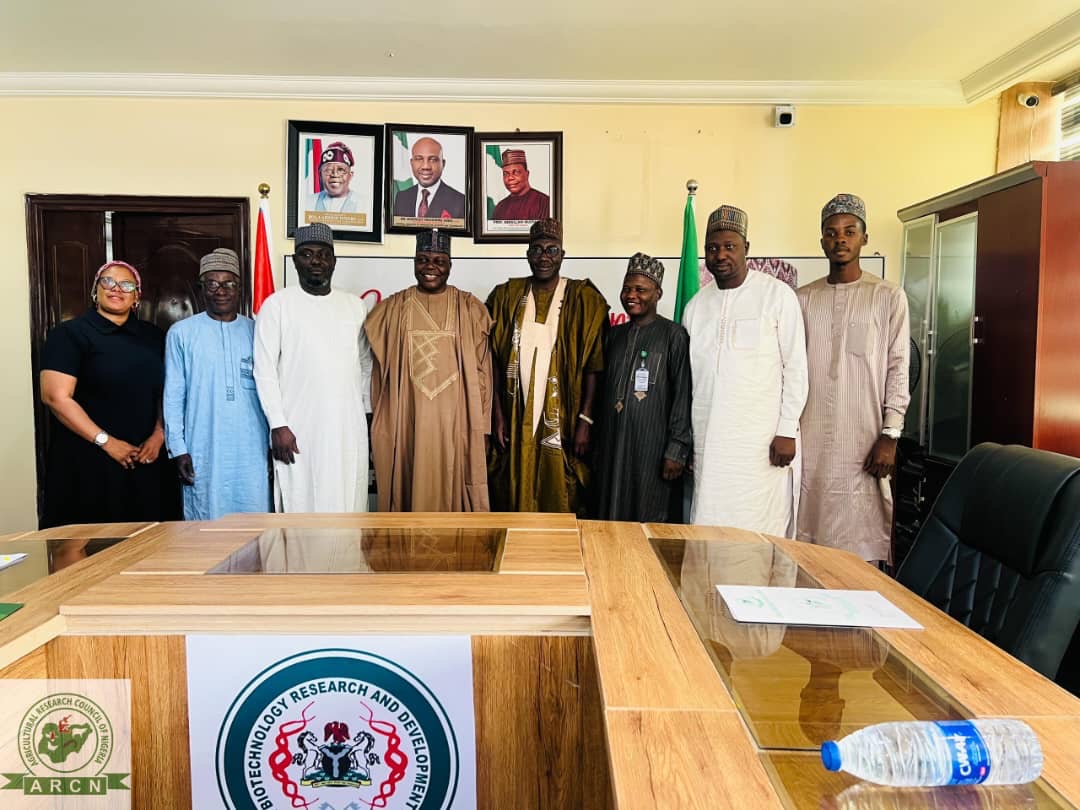
This commitment was restated when the Executive Secretary of ARCN, Dr. Abubakar Adamu Dabban, paid a courtesy visit to the management of NBRDA, with discussions focused on advancing agricultural research, innovation, and biotechnology-driven solutions to Nigeria’s food security challenges.
In an official statement issued by the Public Relations Officer of ARCN, Mrs. Khadijat Oluwatoyin Ameen, the visit was described as a strategic engagement aimed at strengthening collaboration between the two agencies to accelerate agricultural productivity, enhance food sovereignty, and promote sustainable national development.
Speaking during the visit, Dr. Dabban underscored the critical role of biotechnology in addressing persistent agricultural challenges such as climate change, pests and diseases, and low productivity across the value chain. He commended NBRDA for its leadership in promoting safe, innovative, and science-driven biotechnology solutions that support food security and economic growth.
“The Federal Government has elevated agriculture as central to economic recovery, poverty alleviation, and rural employment. Biotechnology stands as a critical enabler of this vision, ensuring that innovations are safe, sustainable, and responsive to the real needs of our farmers and citizens,” Dr. Dabban said.
He further emphasized that under the Renewed Hope Agenda, food security and food sovereignty are strategic national priorities, not mere slogans, noting that the renewed momentum within Nigeria’s biotechnology ecosystem reflects growing regulatory clarity and institutional support.
“Under the Renewed Hope Agenda, food security and food sovereignty are not mere slogans; they are strategic national priorities. Your leadership at NBRDA underscores this reality. Nigeria’s biotechnology ecosystem now has renewed momentum, regulatory clarity, and institutional backing to harness modern biological sciences for crop improvement, livestock resilience, and value-chain development,” he added.
Dr. Dabban explained that strengthening collaborative research frameworks with NBRDA and other relevant agencies would accelerate the development, testing, and deployment of biotechnology outputs that are safe, accessible, and tailored to Nigeria’s diverse agro-ecological zones. He reaffirmed ARCN’s commitment to joint research initiatives, capacity building, and translating scientific findings into practical, farmer-focused solutions.
According to him, priority areas of collaboration include promoting capacity building and knowledge transfer in cutting-edge fields such as genomics, bioinformatics, and precision breeding; facilitating translational research platforms that bridge academic discoveries with farmer-centric outcomes; and aligning regulatory and ethical standards to ensure biotechnology adoption adheres to safety, environmental protection, and societal acceptance while accelerating responsible innovation.
Responding, the Director-General of NBRDA, Professor Abdullahi Mustapha, expressed the agency’s readiness to deepen collaboration with ARCN to advance sustainable agricultural development in Nigeria. He noted that the partnership would enable both institutions to expand research coverage, attract more donor support, and collectively drive inclusive and resilient agricultural systems.
Professor Mustapha appreciated Dr. Dabban for the visit and for his commitment to repositioning the agricultural sector through science, innovation, and strategic collaboration, describing the engagement as timely and impactful.
The visit reaffirmed the shared resolve of ARCN and NBRDA to leverage biotechnology, research, and innovation as tools for achieving food security, economic growth, and national development.
Dr. Dabban was accompanied on the visit by the Director of Planning, Research and Statistics, Dr. Aliyu Shuaibu Madugu; Director of Knowledge Management and Communications, Dr. Nuhu Yusuf; the Public Relations Officer, Mrs. Khadijat Oluwatoyin Ameen, ANIPR; and other principal staff of the Council.