

By Nkechi Eze
The Federal Government has intensified efforts to tackle unemployment and address the shortage of skilled manpower in the country, with over 124,000 Nigerians currently undergoing free technical and vocational training under its Innovation Development and Effectiveness in Acquisition of Skills (IDEAS) Project.
The beneficiaries are receiving monthly stipends of ₦30,000 throughout the six-month training programme, while participating training institutions are paid ₦300,000 for every trainee to facilitate effective delivery of practical skills.
The National Project Monitoring Officer for Technical and Vocational Education and Training (TVET) and IDEAS in the Office of the Minister of Education disclosed this during a monitoring and assessment visit to selected project training centres in Lagos State.
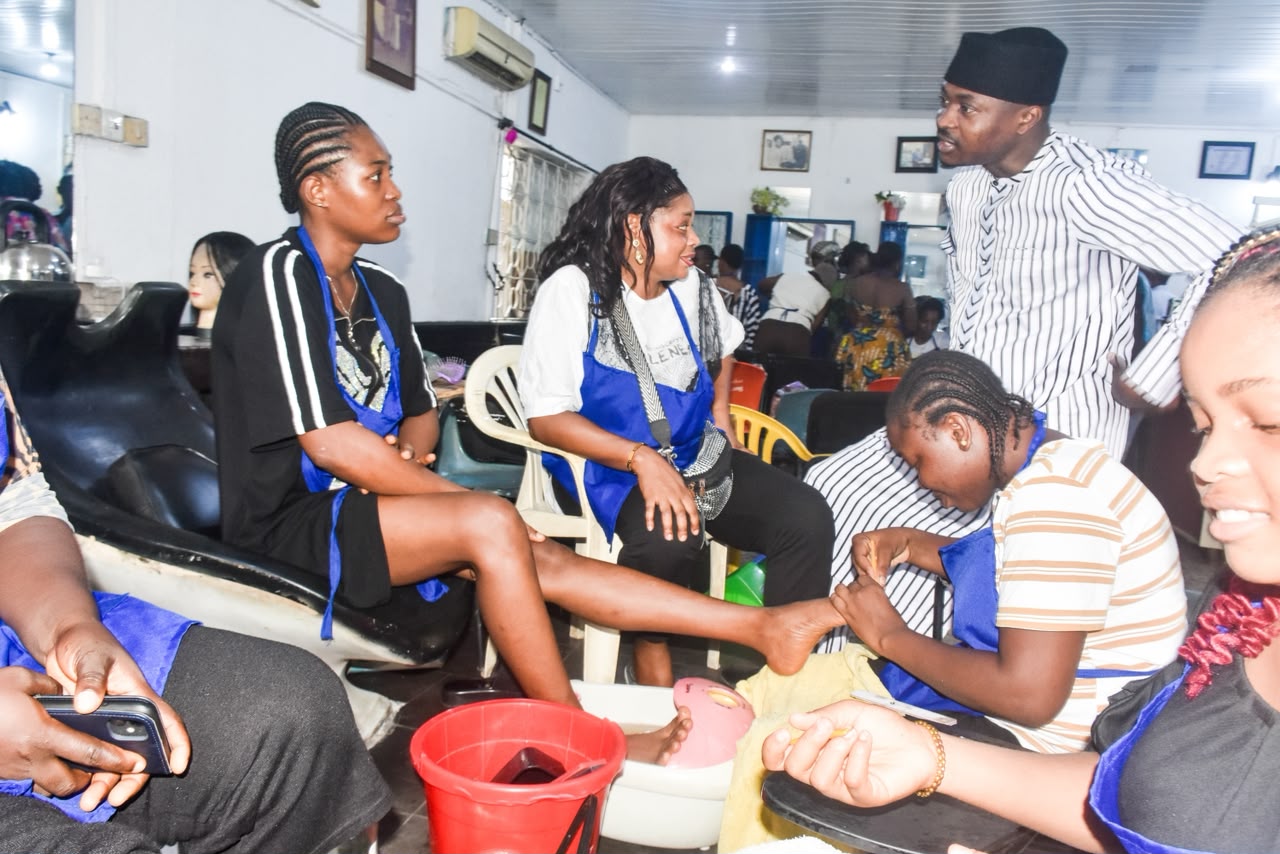
The monitoring exercise covered Elegant Twins Institute of Cosmetology, Surulere, and Federal Technical College (FTC), Yaba, where the team assessed the quality of instruction, institutional capacity, compliance with programme requirements and beneficiaries’ progress.
The Federal Government also provides start-up packages to beneficiaries to enable them to establish businesses and become economically self-reliant after completing their training. Some participants have already started receiving the packages as part of efforts to support their transition from skills acquisition to entrepreneurship.
It was further disclosed that Lagos State has approximately 128 TVET centres participating in the drive to expand access to vocational and technical education.
The IDEAS Project, supported by the World Bank and implemented by the Federal Ministry of Education, is designed to strengthen Nigeria’s technical and vocational education system, improve institutional capacity and equip Nigerians with practical competencies relevant to labour market demands. It also complements the government’s TVET reform agenda under Pillar One of the National Education Sector Renewal Initiative (NESRI).
The intervention is expected to bridge critical skills gaps, reduce dependence on foreign artisans and skilled workers, and provide young Nigerians with opportunities to secure employment or establish their own enterprises.
At Federal Technical College, Yaba, the IDEAS Project Manager, Abimbola Oyedeji, said the programme, which commenced about five years ago, had contributed to increased student enrolment and improved practical training at the institution.
She listed the supported vocational areas to include blocklaying and concreting, tiling, woodwork, auto body building, computer craft and catering craft.
According to her, participants are also acquiring competencies in furniture production, upholstery, carpentry, joinery, panel beating, automobile mechanics, information and communication technology and robotics engineering.
Oyedeji expressed appreciation to the Federal Government for its investment in technical education, noting that the intervention had enhanced the institution’s capacity to prepare students for employment and other opportunities in the world of work.
At Elegant Twins Institute of Cosmetology, the Centre Manager, Kunle Oladunjoye, disclosed that the institution was selected as a training service provider to equip 75 beneficiaries with professional skills in beauty and cosmetology.
He described the selection process as transparent and merit-based, involving interviews and verification of applicants’ information.
Oladunjoye said experienced professional instructors, including former students with substantial industry experience, were engaged to deliver the training, adding that beneficiaries were making encouraging progress towards acquiring the skills needed to establish businesses in the beauty industry.
He commended the Federal Government for fulfilling its financial obligations to the training centre and providing monthly stipends for participants.
The institute’s founder, Mrs Elizabeth Adebisi Oshisoya, who traced her involvement in cosmetology training to 1950, described the intervention as an important opportunity to widen access to professional vocational education.
She recalled her longstanding involvement in skills training across Ibadan, Ijebu and Calabar, expressing appreciation to the Federal Government for supporting vocational empowerment and economic self-reliance.
Some beneficiaries also shared their experiences, highlighting the impact of the programme in providing free professional training and financial support.
At Elegant Twins Institute, Abdulhakeem Shamsudeen said he had expanded his knowledge of nail technology and makeup, while Omotosho Okwemi commended the government for making the training free and providing financial assistance.
Another beneficiary, Boma Messe-Britz, said she had acquired practical skills in makeup, hairdressing, nail technology and spa services. The participants praised their instructors and urged the government to sustain the programme to enable more Nigerians to benefit.
Similarly, at Federal Technical College, Yaba, Leo Uzoma commended the provision of free training and equipment, noting that access to appropriate facilities had improved his practical learning experience.
Oni Oluwada said the programme had strengthened his knowledge of electrical installation, including basic electrical connections and socket installation, while Adebayo Mowufin Oluwada explained that the training was helping her build the technical foundation required for further studies and a career in electrical engineering.
The monitoring exercise is part of the Federal Ministry of Education’s efforts to ensure accountability, maintain training standards and guarantee that investments in vocational education translate into measurable benefits for participants and institutions.
The Federal Government reaffirmed its commitment to sustaining the IDEAS Project and other TVET interventions through continued investment, institutional capacity development and quality assurance, with a focus on producing a skilled workforce capable of meeting industry demands, creating employment and contributing to Nigeria’s economic transformation.