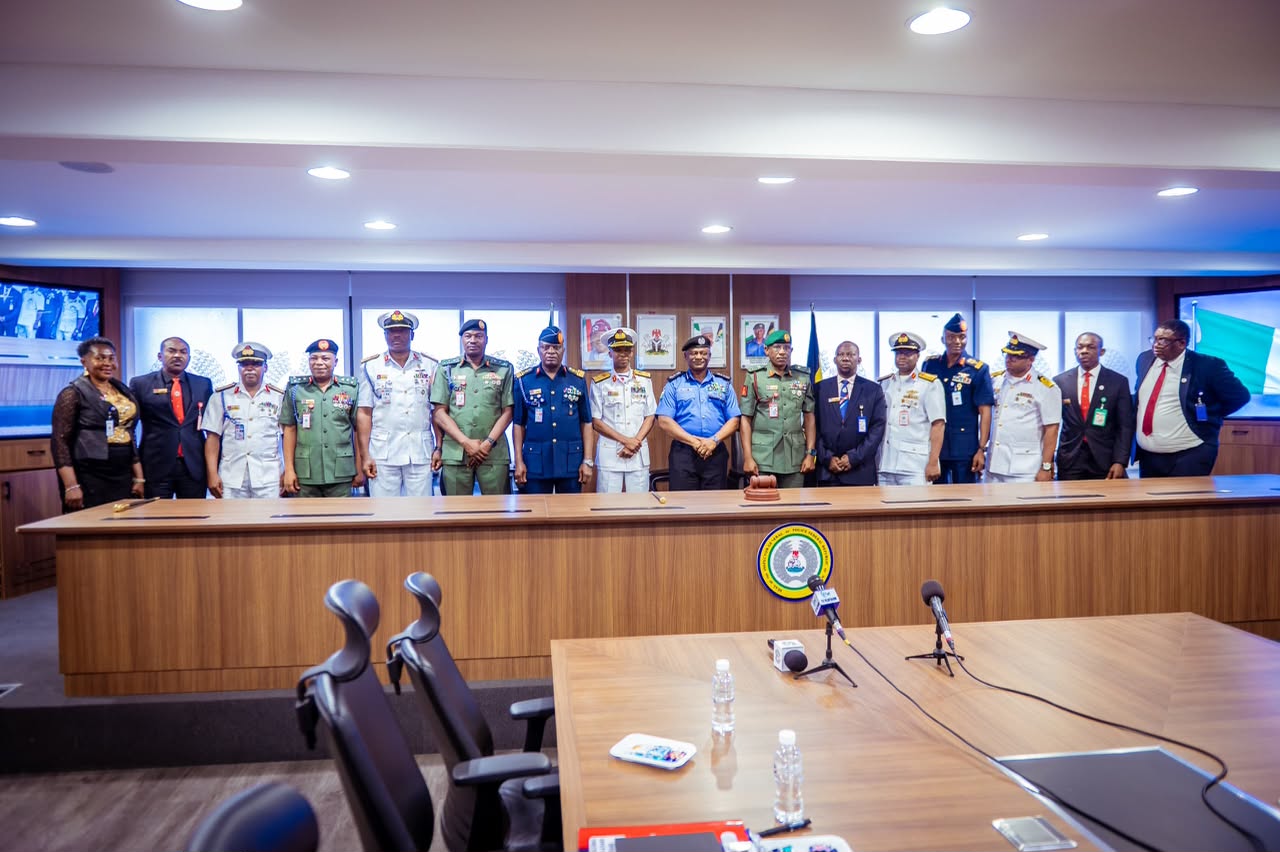
The Inspector-General of Police, IGP Olatunji Disu has reaffirmed the Nigeria Police Force’s commitment to comprehensive police reform, the development of an effective state policing framework, and stronger collaboration with strategic security institutions as part of efforts to tackle Nigeria’s evolving internal security challenges.
The commitment was made on Tuesday during a courtesy visit by the leadership, management, directing staff, participants, and support staff of the National Defence College (NDC) to the Force Headquarters in Abuja.
According to an official statement signed by the Force Public Relations Officer, DCP Anthony Placid, discussions during the meeting focused on critical national security issues, including police reform, state policing, command and coordination protocols, and other emerging internal security concerns confronting the country.
The National Defence College delegation was led by its Commandant, Rear Admiral A. Ahmed, alongside senior members of the institution, including the Deputy Commandant and Director of Studies, Major General K. E. Chigbu; the College Secretary, Air Vice Marshal E. Owai; the Provost of the Centre for Strategic Research and Studies (CSRS), Professor A. O. Ahmad; Brigadier General G. Oyinlola; Brigadier General J. M. Chima; Commodore A. N. Umaru; Colonel M. Haribu; Colonel T. O. Samson; Colonel M. I. Ajibike; and Colonel A. A. Abdulhalim. Also in attendance were police participants at the College, including Commissioner of Police S. A. Afunluhi, Deputy Commissioners of Police S. Yahaya, O. O. Yusuf, and I. B. Usang.
During the visit, the Commandant of the National Defence College presented the outcome of a strategic research paper produced by police officers undergoing studies at the institution. He explained that the work was the product of extensive research undertaken solely by the participating police officers, while the College’s faculty provided only academic supervision and methodological guidance throughout the process.
Rear Admiral Ahmed noted that the participants drew on their operational experience, professional knowledge, and critical thinking skills to develop practical and implementable policy options aimed at addressing the country’s contemporary and future policing needs. He expressed confidence that the study’s findings and recommendations would make meaningful contributions to the national discourse on police reform and enhance the operational effectiveness of the Nigeria Police Force in responding to emerging security threats up to the year 2035.
Responding, IGP Disu described the research as both timely and strategic, noting that Nigeria’s rapidly changing security environment requires innovative, evidence-based policies supported by rigorous academic research and operational experience.
The Inspector-General commended the officers for producing what he described as a comprehensive, well-researched, and practically relevant study capable of supporting ongoing efforts to reposition the Nigeria Police Force for improved service delivery.
He particularly highlighted the study’s relevance to ongoing discussions on the establishment of state policing in Nigeria, stating that its robust methodology, extensive analysis of public concerns, and recommendations drawn from comparative studies of countries operating state police systems provide a valuable foundation for shaping an effective and sustainable framework.
The police chief observed that reforms within modern policing must be driven by informed research, collaboration, and institutional learning to ensure they effectively respond to emerging criminal trends and the country’s unique security realities.
He further stressed that the Nigeria Police Force remains committed to strengthening partnerships with academic and strategic institutions such as the National Defence College to improve policy formulation, enhance operational capacity, and promote intelligence-driven policing.
The meeting also underscored the importance of inter-agency collaboration in addressing increasingly complex security challenges, with both institutions emphasizing the need for stronger coordination among security stakeholders to improve national security outcomes.
The Inspector-General reiterated that the Force would continue to work closely with the National Defence College and other relevant institutions in advancing reforms designed to improve policing standards, strengthen internal security architecture, and support national development.
The visit reflects the growing collaboration between Nigeria’s security institutions in integrating academic research with operational policing, as the Nigeria Police Force continues to pursue reforms aimed at building a more professional, accountable, and effective policing system capable of addressing both present and future security challenges.