


By Nkechi Eze
The Chairman of the Independent National Electoral Commission, Joash Amupitan, has emphasised the need for stronger institutional capacity within the Commission as preparations intensify for the 2027 Nigerian general election, warning that new electoral timelines require faster and more precise operational planning.
Amupitan made the remarks in a welcome address delivered on his behalf by National Commissioner, May Agbamuche-Mbu, at the opening of a three-day capacity-building workshop for National Electoral Commissioners and senior management staff of the Commission in Lagos on Monday.
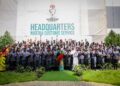
The workshop, organised in collaboration with the Konrad-Adenauer-Stiftung Nigeria office, brought together National Commissioners, directors, technical aides to the chairman, electoral experts, stakeholders and members of the media to strengthen institutional capacity within the electoral body.
Welcoming participants, the INEC chairman described the workshop as a critical step toward strengthening the Commission’s ability to effectively deliver credible elections.
“It is with a deep sense of responsibility and institutional purpose that I welcome you all to this important three-day capacity-building workshop,” he said. “This initiative reflects our collective commitment to enhancing the capacity and capabilities of the National Electoral Commissioners and the management team at INEC.”
He expressed appreciation to the Konrad-Adenauer-Stiftung for its technical partnership and continued support to Nigeria’s electoral management body.
“We wish to convey our profound gratitude to the Konrad-Adenauer-Stiftung, Nigeria, for their technical partnership in facilitating this exercise,” he said.
Amupitan noted that the Commission was meeting at a defining moment in Nigeria’s democratic journey, pointing out that the workshop was taking place exactly 159 days after he assumed leadership of the Commission on October 23, 2025.
“We meet at a watershed moment in our democratic journey,” he stated. “My primary mandate, and indeed our collective burden, is to ensure that the electoral architecture of Nigeria is not just robust in theory, but strong in practice.”
He reminded participants that their responsibilities extend beyond merely organising elections.
“Our work is not just about conducting elections; it is about ensuring that the democratic process thrives in our great nation,” he said. “It is imperative that we equip ourselves with the necessary skills, knowledge and tools to uphold the integrity, transparency and credibility of our electoral system.”
The INEC chairman also drew attention to the implications of the recently enacted Electoral Act 2026, noting that the legislation has significantly altered the Commission’s operational framework.
“The recent enactment of the Electoral Act 2026, which was assented to just weeks ago in February, has fundamentally recalibrated our statutory windows,” he explained.
According to him, the amendment to Clause 28 of the Act reduced the mandatory notice period for elections from 360 days to 300 days, thereby creating what he described as a compressed operational environment.
“This change creates a compressed operational environment that demands we work with unprecedented speed and surgical precision,” he said.
Amupitan further disclosed that the Commission had already released a revised timetable and schedule of activities for the 2027 general elections.
“Presidential and National Assembly elections are now set for Saturday, January 16, 2027, while Governorship and State Assembly elections will follow on Saturday, February 6, 2027,” he announced.
He explained that the workshop would provide an opportunity for participants to interact with expert facilitators, engage in discussions and explore innovative strategies that will help the Commission address emerging operational challenges, particularly in the area of procurement.
“Over the next three days, we will engage with expert facilitators, participate in enriching discussions and explore innovative strategies that will empower us to tackle the challenges ahead,” he said.
Encouraging active participation, the INEC chairman urged participants to maximise the opportunity to learn and collaborate.
“I encourage each of you to actively participate, ask questions, share your experiences and absorb as much knowledge as you can,” he said. “The strength of our Commission lies in our willingness to learn and adapt, and together we can ensure that our elections reflect the will of the people we serve.”
He concluded by once again appreciating the support of the Konrad-Adenauer-Stiftung and reaffirming the Commission’s commitment to strengthening Nigeria’s democratic process.
“Let us seize this opportunity to grow and strengthen INEC, and by extension, the democratic fabric of Nigeria,” he added.