


By Nkechi Eze
The National Youth Service Corps has called on Corps Producing Institutions across the country to strengthen their internal data validation mechanisms in order to safeguard the credibility and integrity of the mobilisation process, warning that any form of data manipulation or fraudulent mobilisation would attract stiff sanctions.
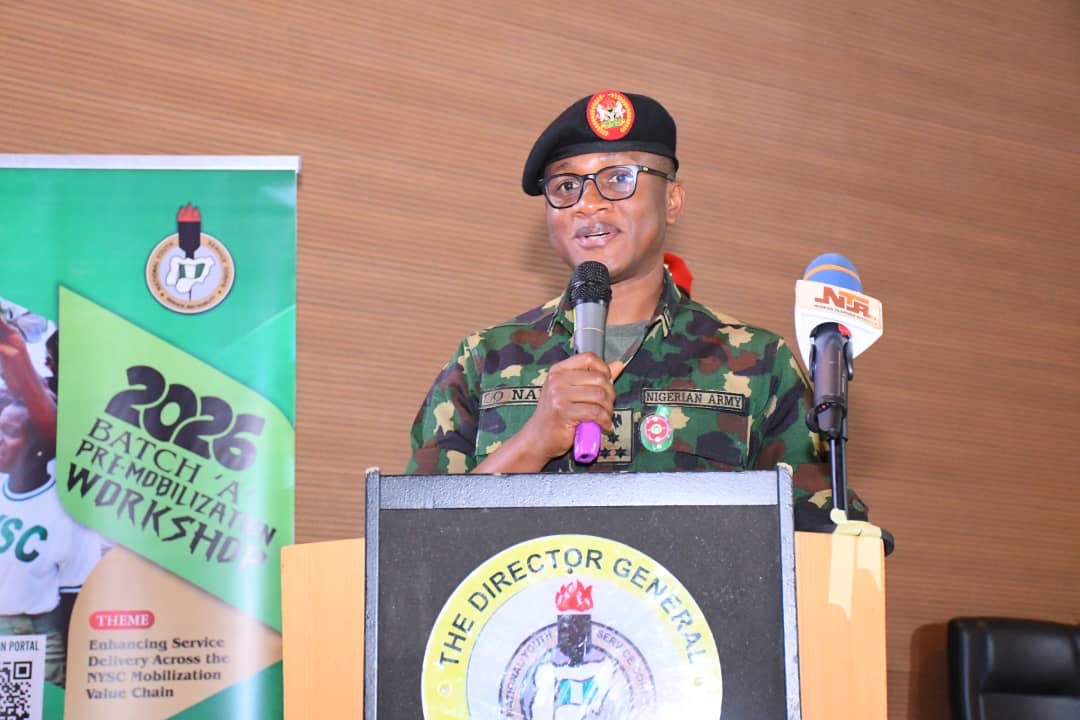
The Director General of the NYSC, Brigadier General Olakunle Nafiu, made the call while addressing participants at the 2026 Batch ‘A’ Pre-Mobilisation Workshop held on Wednesday in Abuja. The workshop, themed “Enhancing Service Delivery Across the NYSC Mobilisation Value Chain,” brought together key stakeholders involved in the production, validation and mobilisation of Prospective Corps Members. The position of the Scheme was contained in an official statement signed by the Director, Information and Public Relations, Caroline Embu.
In his address, Nafiu stressed that the mobilisation process remained a critical pillar of the NYSC mandate and must be protected from errors, sharp practices and systemic weaknesses that could erode public trust. He urged heads of Corps Producing Institutions to exercise stronger oversight over mobilisation activities within their institutions, while also ensuring that Desk Officers handling mobilisation data were adequately trained and regularly updated on evolving standards and emerging technologies.
The Director General reaffirmed the commitment of the NYSC Management to its Standard Operating Procedures, noting that the Scheme would continue to strengthen collaboration across its departments, area offices and state secretariats. He added that performance monitoring and evaluation mechanisms would be enhanced, alongside renewed emphasis on discipline, professionalism and ethical conduct at all levels of operation.
According to Nafiu, improving service delivery within the mobilisation value chain required deeper inter-agency collaboration, regular stakeholder review meetings and a stronger culture of data-driven decision-making anchored on clearly defined timelines and responsibilities. While assuring stakeholders that the NYSC leadership remained committed to discharging its responsibilities with patriotism and integrity, he appealed for sustained cooperation in the collective pursuit of excellence.
“As we look ahead, the NYSC mobilisation process must be repositioned to be efficient, transparent, accountable and people-focused,” Nafiu said. “This involves delivering timely and accurate results, free from undue influence, with clear accountability for actions and inactions, while remaining responsive to the needs of Prospective Corps Members and other stakeholders. Improving service delivery throughout the mobilisation value chain is, therefore, not optional; it is both imperative and urgent.”
He described the mobilisation process as a complex ecosystem of interconnected actors and systems, encompassing the production, validation, mobilisation, deployment and management of Prospective Corps Members. While acknowledging the significant progress recorded in digital mobilisation, the NYSC boss said the Scheme continued to observe challenges such as poor data quality at the source, limited technical skills among some system operators, resistance to full automation and inadequate feedback mechanisms.
Nafiu expressed concern over practices that undermine the integrity of the mobilisation process, including violations of established guidelines, the upload of unqualified graduates, inconsistent academic records, data discrepancies and intentional record manipulation for personal or illegal gains. He also identified weak internal verification systems within some institutions as a major source of vulnerability. He warned that Corps Producing Institutions found culpable of fraudulent mobilisation would face appropriate sanctions in line with existing regulations.
Earlier in her welcome address, the Director of the Corps Mobilisation Department, Mrs Rachel Idaewor, charged Student Affairs Officers to approach their responsibilities with diligence, honesty and a strong sense of accountability. She urged them to ensure that all information submitted for mobilisation accurately reflected the true academic and personal profiles of Prospective Corps Members.
Idaewor highlighted the importance of collaboration with critical stakeholders in the mobilisation process, including the Federal Ministry of Education, the Joint Admissions and Matriculation Board, the National Board for Technical Education, the National Universities Commission and SIDMACH Technologies. Describing these partnerships as invaluable to the success of the Scheme, she said, “We should all come together as a cohesive team, drawing inspiration from our past successes while embracing the challenges that lie ahead.”
The workshop was attended by Student Affairs Officers from all Corps Producing Institutions in Nigeria, alongside representatives of the National Universities Commission, SIDMACH Technologies and other relevant agencies, as the NYSC continues efforts to strengthen transparency, efficiency and credibility in its mobilisation process.