

By Nkechi Eze
The Chief of Defence Staff (CDS), General Olufemi Oluyede, has called for a delicate balance between media freedom, transparency and operational security, warning that indiscriminate disclosure of sensitive military information could endanger troops and compromise ongoing security operations.
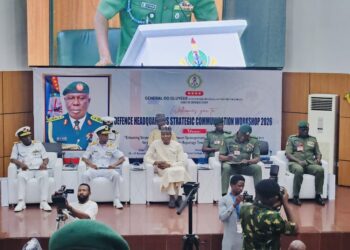
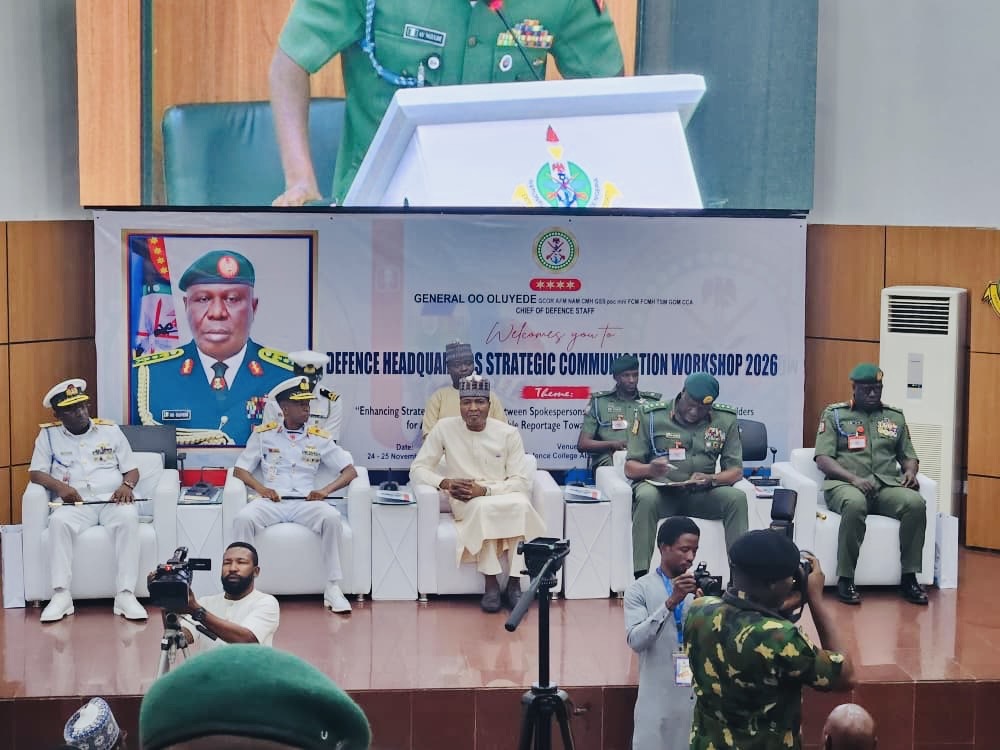
Oluyede made the call on Tuesday in Abuja at the opening of the 2026 Defence Headquarters Strategic Communication Workshop, where he identified the media as an increasingly critical component of modern warfare and a strategic partner in the pursuit of national security objectives.
The CDS noted that the contemporary security environment had evolved beyond conventional battlefield engagements to include physical, informational and cognitive dimensions of warfare, making the ability to communicate effectively and shape public perceptions essential to military success.
According to him, the media had become an institutionalised line of operation in modern security engagements, with the capacity to influence public understanding, counter threats, dispel false narratives and sustain confidence in the Armed Forces.
“The nature of today’s conflicts is no longer determined exclusively by the ability to defeat adversaries on the battlefield, but also by the capacity to communicate effectively, shape perceptions and sustain public confidence,” he said.
He explained that credible and timely reporting helps Nigerians understand the rationale behind military operations, thereby strengthening public trust, confidence and support for the Armed Forces.
However, Oluyede warned that the media’s responsibility to inform the public must be exercised with due consideration for operational security, particularly in reporting sensitive military activities.
He cautioned against indiscriminate disclosure of troop movements, operational locations, military capabilities and other classified details, noting that such disclosures could expose personnel to danger and undermine ongoing operations.
“While I strongly believe in the importance of transparency, access to information and constructive engagement, I also recognise the need to protect sensitive military information,” the CDS stated.
He stressed that operational security remained a fundamental component of national security and must be respected by all stakeholders, urging media practitioners to appreciate the implications of publishing sensitive information.
The Defence Chief also expressed concern over the increasing spread of misinformation and manipulated content, particularly through Nigeria’s expanding media landscape and social media platforms.
He observed that old videos and images were sometimes misrepresented as current incidents, creating unnecessary fear and undermining public confidence.
He further warned that artificial intelligence had intensified the challenge through fabricated images, audio recordings, videos and generated scenarios that could easily appear authentic to unsuspecting audiences.
The CDS consequently urged journalists and military communication professionals to strengthen their capacity to identify and verify synthetic content before dissemination.
“As responsible professionals, we must not allow the speed of information dissemination and sensationalism to take precedence over accuracy, credibility and responsible reporting,” he said.
He also charged military commanders to ensure that information released to the media was accurate, factual and credible, emphasising that effective communication structures, sustained engagement and specialised training were essential to improving military-media relations.
In his remarks, the Minister of Information and National Orientation, Mallam Idris Mohammed, represented by the Director-General of Voice of Nigeria, Mallam Jibrin Baba-Ndace, also called for stronger collaboration between security agencies and the media, stressing that both institutions had complementary responsibilities in protecting national interests.
He said while the military was responsible for defending the country, the media had a constitutional responsibility to inform the public, express diverse perspectives and report matters of public interest.
According to him, the two responsibilities were not incompatible but required mutual respect, professionalism and regular communication.
“Security agencies must provide timely and credible information, while journalists must ensure accurate reporting, provide context and avoid publishing information that could unnecessarily endanger lives or compromise ongoing operations,” he said.
The minister warned that poor reporting could generate fear, deepen public distrust and undermine confidence in security institutions, while silence or delayed communication during major security incidents could create information gaps that misinformation and speculation could exploit.
He, however, clarified that responsible journalism should not be interpreted as an attempt to shield security institutions from legitimate scrutiny or restrict the independence of the media.
“The issue is not about controlling journalists or restricting their professional independence. It is about ensuring that the media and security agencies understand the implications of their actions and operate responsibly,” he stated.
Mohammed further emphasised that the call for responsible communication was not an endorsement of censorship but an appeal for professionalism and a balance between citizens’ right to information and the protection of sensitive security operations.
“This is not a call for censorship. Rather, it is a call for responsible communication,” he declared.
Highlighting the operational efforts of the Armed Forces, the minister disclosed that reports for the first half of 2026 indicated that the military conducted 14,231 operations across different theatres and rescued 1,016 kidnapped victims.
He urged media organisations to give balanced attention to the country’s security challenges as well as the successes recorded by security personnel and the sacrifices made in protecting the nation.
“This does not mean abandoning critical journalism. Rather, it calls for balanced reporting that acknowledges both the challenges and the progress being made,” he said.
The minister also disclosed that the Federal Government initiated efforts in October 2026 towards developing a comprehensive National Threat Assessment and a rolling five-year strategy for defence and security operations, aimed at improving coordination among defence, intelligence and security institutions.
He further highlighted the establishment of the International Media and Information Literacy Institute in April 2026 through a partnership between Nigeria and UNESCO, describing it as an important step towards building citizens’ capacity to identify misinformation and critically assess information.
Mohammed urged participants to use the workshop to develop practical recommendations for improving communication channels, establishing mechanisms for correcting inaccurate reports and building a shared understanding of the operational realities confronting security agencies and journalists.
He maintained that both institutions ultimately served the same country and its citizens, stressing the need for a sustainable framework of cooperation that would protect national security without undermining the media’s professional independence.
“Both institutions work for the same country and ultimately serve the same people. They must therefore find common ground and develop a sustainable framework for cooperation,” he said.
The minister subsequently declared the 2026 Defence Headquarters Strategic Communication Workshop open, expressing optimism that its deliberations would produce recommendations to strengthen collaboration between the security community and the media.