

By Nkechi Eze
The National Information Technology Development Agency (NITDA) has led calls for a coordinated response to emerging cybersecurity threats associated with Artificial Intelligence (AI), as experts warn that the technology is creating new vulnerabilities for critical infrastructure, telecommunications networks and financial systems.
The call was made at the second International Cybersecurity Conference, organised by NITDA, where experts from the Nigerian Communications Commission (NCC), the International Telecommunication Union (ITU) and the Central Bank of Nigeria (CBN) highlighted the need for stronger security standards, effective regulation, skilled personnel and improved collaboration to address AI-enabled cyber threats.
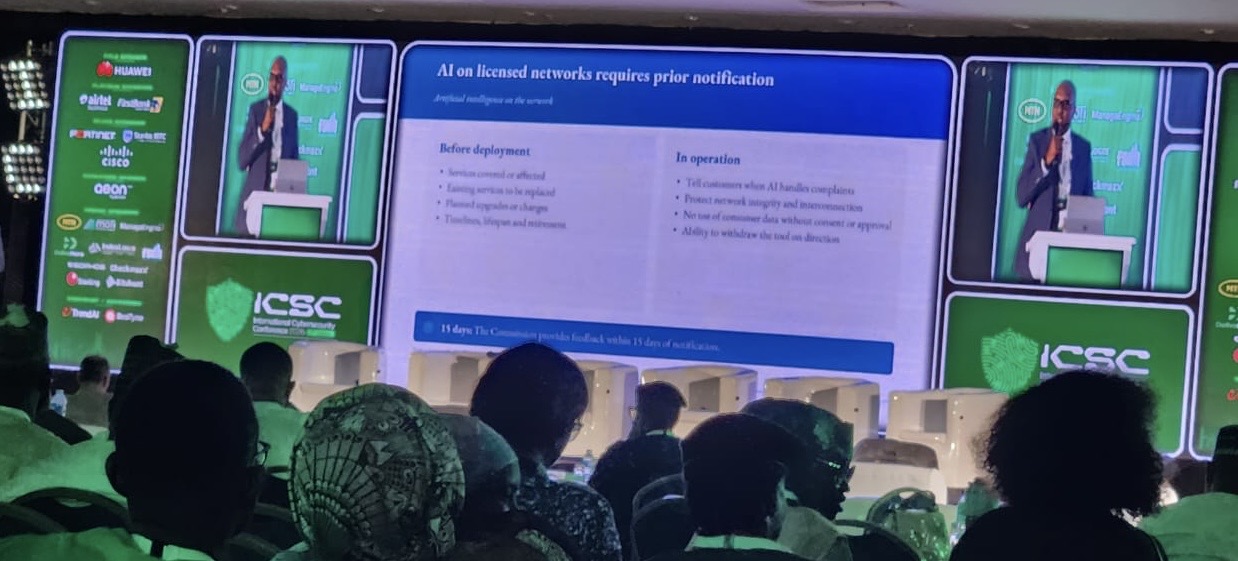
Speaking at the conference, Musa Daibu, Head of Fixed Network and Converged Services, Technical Standards and Network Integrity at the NCC, said AI offered significant opportunities for strengthening cyber defence but could also be exploited by malicious actors to increase the scale and sophistication of attacks.
“AI can be used to strengthen cyber defence and it can also be used to scale cyber threats,” Daibu said.
He explained that while AI could support faster threat detection and response, cybercriminals could deploy the technology for automated attacks, sophisticated phishing schemes and impersonation.
Daibu called on regulators to establish minimum cybersecurity requirements for AI-enabled networks, strengthen technical standards and ensure effective monitoring, audits, risk management and disaster recovery arrangements.
He also stressed the need to review the NCC’s Cyber Resilience Framework and related guidance notes to address emerging risks associated with AI.
According to him, effective cybersecurity requires shared responsibility among regulators, network operators, government and technology providers. While regulators must establish and enforce standards, operators must protect their networks and ensure safe recovery from incidents, and technology providers must integrate security into their products from the design stage.
Also speaking, Zongo Serge Valery, Senior Cybersecurity Coordinator at the ITU, said AI could improve infrastructure resilience and data analysis but could equally help attackers identify vulnerabilities and execute cyberattacks more quickly.
“AI can improve resilience for our infrastructure. But this can be done only if security, accountability and human oversight are really put in from the beginning,” Valery said.
He identified shortages of specialised cybersecurity personnel, inadequate technical skills, limited threat intelligence and weak coordination as major challenges facing Africa’s cybersecurity ecosystem.
Valery called for anticipatory governance, clear preparedness measures, cross-sector cooperation and agile, risk-based regulation to strengthen the continent’s ability to respond to evolving cyber threats.
He said Nigeria needed to translate existing laws and policies into coordinated operational readiness, including a national resilience framework for critical infrastructure, mandatory security standards, clearly defined responsibilities and effective incident-response mechanisms.
“Laws are in place, but Nigeria should translate them into coordinated operational readiness,” he said.
In her keynote address, Mrs Omoyemen Jide-Samuel, Director of the Information Technology Department at the CBN, warned that AI-powered deepfakes, voice and video impersonation, and synthetic identities were increasing the risks of fraud within the financial sector.
She said financial institutions could no longer rely solely on seemingly authentic voices, documents or video recordings to verify instructions, as such materials could be generated or manipulated using AI.
“Identity must be continuously assured. Authority must be independently verified,” Jide-Samuel said.
She urged financial institutions to strengthen identity verification and introduce additional checks involving transactions, devices and beneficiaries, while ensuring that human oversight remained part of decisions supported by AI.
According to her, AI could help identify suspicious transaction patterns, but its outputs must not be accepted without appropriate verification.
Jide-Samuel also emphasised the importance of rapid executive-level responses to cyber incidents, clear protocols for contacting receiving institutions, preservation of evidence, customer support and timely escalation of suspicious transactions.
She called for stronger coordination among financial institutions, telecommunications operators, technology companies, law enforcement agencies and regulators to improve the prevention, detection and response to cyber-enabled financial crimes.
Citing figures presented in her address, she said digital payment fraud losses declined from N52.26 billion in 2024 to N25.85 billion in 2025, representing a reduction of about 51 per cent. However, she warned that fraud remained a serious threat to public confidence, financial inclusion and economic activity.
The discussions reinforced the need for a coordinated national approach to cybersecurity as AI becomes increasingly integrated into telecommunications, financial services and other critical systems.
The experts stressed that addressing the emerging threats would require more than technological solutions, calling for stronger regulatory frameworks, continuous capacity building, clear institutional responsibilities and collaboration between government agencies and private-sector operators.
The conference, organised by NITDA, highlighted the importance of ensuring that the adoption of AI is matched by effective safeguards, accountability and preparedness to protect Nigeria’s digital infrastructure against increasingly sophisticated cyberattacks.