


The Independent National Electoral Commission (INEC) has established a dedicated Artificial Intelligence (AI) Unit as part of efforts to strengthen electoral processes and address emerging technology-driven threats ahead of the 2027 General Election.
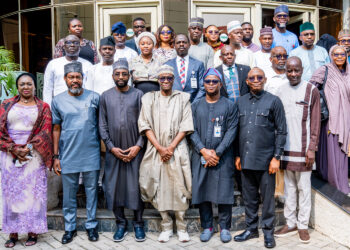
The INEC Chairman, Prof. Joash Ojo Amupitan, disclosed this on Friday in Abuja when the Chargé d’Affaires of Canada to Nigeria, Mr David Sproule, led a delegation of the Canadian High Commission on a courtesy visit to the Commission’s headquarters.
Amupitan said the establishment of the AI Unit was part of the Commission’s efforts to remain proactive and responsive to emerging challenges in the global electoral landscape.
“In our quest to remain proactive and responsive to modern challenges, I am pleased to inform you that the Commission has recently established a dedicated Artificial Intelligence (AI) Unit,” he said.
He explained that INEC intended to harness AI to improve data management, voter registration and results transmission, while remaining vigilant against the misuse of the technology.
“As technology continues to reshape the global electoral landscape, we recognise the need to harness the power of AI to improve data management, voter registration, and results transmission, while remaining vigilant against the misuse of such technologies,” Amupitan said.
The INEC Chairman identified deepfakes and disinformation as emerging threats capable of undermining public confidence in elections, stressing the need for stronger collaboration with international partners.
“The conference presents a timely opportunity for our Commission to deliberate on the responsible deployment of AI and to develop robust strategies to counter AI-driven threats like deepfakes and disinformation, which pose significant risks to electoral integrity worldwide,” he said.
Amupitan therefore sought stronger partnership with Canada on strategic communications, civic education, technology and institutional capacity building as the Commission intensifies preparations for the 2027 elections.
He said INEC was particularly interested in consolidating the reliability, field deployment and cybersecurity of its electoral technologies based on lessons from recent off-cycle elections.
The INEC Chairman also disclosed that the Commission would conduct a mock accreditation exercise in November 2026 to assess its readiness for the 2027 General Election and subject the Bimodal Voter Accreditation System (BVAS) to rigorous field testing.
“We will be subjecting our electoral equipment, the Bimodal Voter Accreditation System (BVAS), to a rigorous field test to fortify the sanctity of the ballot during the election. We will appreciate your partnership in ensuring the success of this Mock Accreditation,” he said.
Amupitan highlighted the recently concluded Osun State governorship election as a benchmark for the Commission’s preparations, noting that 3,556 of the 3,763 polling units, representing 94.5 per cent, opened for accreditation and voting by 8:30 a.m.
He said the Commission also recorded optimal BVAS performance, seamless result uploads on the INEC Result Viewing (IReV) portal and proactive crisis management during the election.
“Osun demonstrated what is possible when administrative foresight meets technological fortitude,” Amupitan said, adding that the performance would serve as a standard for the Commission’s preparations for 2027.
He said INEC would build on the experience as it prepares for the 2027 polls, with the Presidential and National Assembly elections scheduled for January 16, 2027, and the Governorship and House of Assembly elections for February 6, 2027.
Amupitan further disclosed that INEC was preparing to deploy approximately 1.4 million ad-hoc personnel across more than 176,000 polling units nationwide during the 2027 elections.
He said the scale of the operation would require effective planning and collaboration with relevant stakeholders to ensure efficient electoral administration.
The INEC Chairman also reaffirmed the Commission’s commitment to expanding electoral participation among persons with disabilities, women, youths and other historically underrepresented groups.
He said electoral administration was a multi-stakeholder responsibility and that international partnerships remained important to strengthening Nigeria’s democratic institutions.
“While INEC remains an unbiased umpire, support from domestic and international partners helps ensure our democratic processes evolve in step with global best practices,” he said.
Amupitan said INEC looked forward to participating in the Global Conference on Responsible AI and Elections, scheduled for September 9 to 11, 2026, in Ottawa, Canada, organised by the United Nations Development Programme (UNDP) and Elections Canada.
He said the conference would provide an opportunity for electoral stakeholders to develop strategies for the responsible deployment of AI and to counter threats such as deepfakes and AI-generated disinformation.
The INEC Chairman also appealed to the Canadian authorities to facilitate expedited processing of entry visas for members of the Commission’s delegation attending the conference.
Amupitan expressed appreciation for Canada’s continued support for Nigeria’s democratic development and reassured the Canadian delegation of INEC’s independence, neutrality and commitment to credible elections.
“I want to reassure you and the international community of this Commission’s absolute independence, neutrality, and unyielding commitment to democratic integrity,” he said.