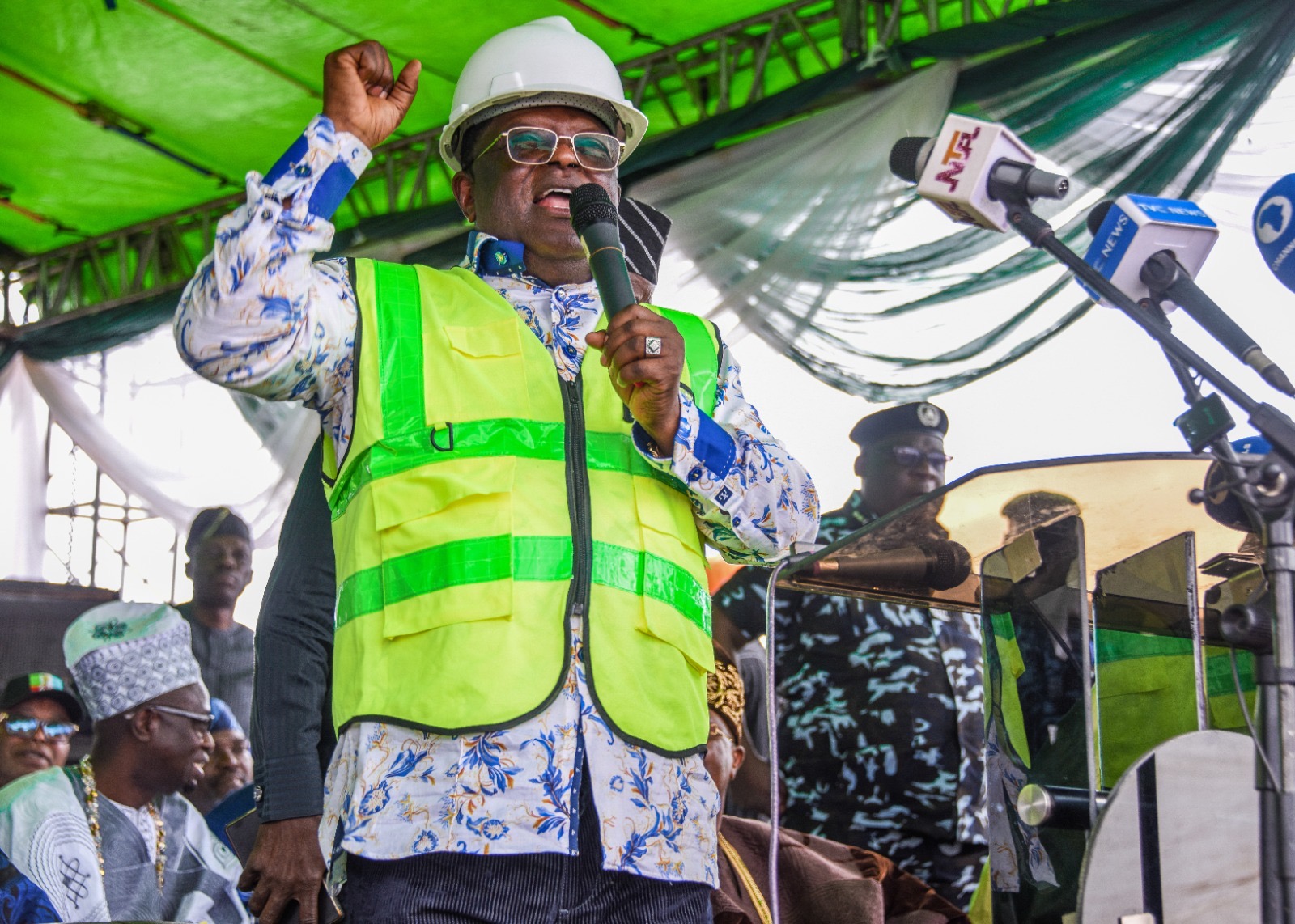
The Minister of Works, Senator Engr. David Umahi has explained that the Federal Government’s intervention on the Benin–Onitsha Road is constrained by an existing concession agreement, insisting that government cannot arbitrarily terminate the arrangement without due process.
Umahi said the 125-kilometre Benin–Asaba Expressway was incorporated into the Federal Government’s Highway Development and Management Initiative (HDMI) as a Value-Added Concession, placing the development and management of the corridor within a contractual framework.
According to an official statement signed by Mohammed A. Ahmed, Director, Information and Public Relations, the Federal Ministry of Works has been engaging the concessionaire over the pace of work and demanding improved performance on the road.
The Minister stressed that the concession arrangement did not mean the Federal Government had abandoned the corridor, but that its responsibilities must be exercised within the confines of the law and existing contractual obligations.
“Government is bound by law. It is bound by contract. And it must observe due process,” Umahi said.
He explained that terminating the concession agreement arbitrarily could expose the Federal Government to litigation and significant financial claims, adding that the Ministry was therefore focused on using lawful mechanisms to compel the concessionaire to fulfil its obligations.
Umahi’s explanation followed criticism over the deteriorating condition of the Benin–Onitsha corridor, with concerns raised over the impact of the road on motorists, businesses and economic activities.
The Minister rejected the suggestion that the present condition of the road was created by the administration of President Bola Ahmed Tinubu, saying the administration inherited a vast network of deteriorating federal roads and bridges.
He said the condition of the Benin–Onitsha Road should be viewed against the broader infrastructure deficit inherited by the administration, as well as the contractual and funding challenges affecting several federal road projects.
Umahi also highlighted the Federal Government’s ongoing road interventions across the South-East, including the Enugu–Akwa-Onitsha Expressway, Onueke Highway and Flyover, Calabar–Ebonyi–Benue Trans-Sahara Superhighway, Enugu–Abakaliki–Ogoja Road, Afikpo–Okigwe Road, access roads to the Second Niger Bridge, Aba–Owerri Road, Onitsha–Owerri Expressway, Enugu–Port Harcourt Expressway and Aba–Ikot Ekpene Road.
He further cited the reconstruction of the Enugu–Onitsha Expressway, noting that an initial 15-kilometre completed section was reopened in April 2026.
According to the Minister, the Federal Government has also been reviewing inherited highway concession agreements since 2025 to address concerns relating to transparency, accountability, performance and value for money.
Umahi maintained that the Ministry had not ignored the condition of the Benin–Onitsha corridor, stressing that it had continued to engage the concessionaire and demand compliance with its contractual obligations.
He acknowledged the hardship faced by road users, including delays, vehicle damage and safety concerns, but said the solution must be pursued within the legal framework governing the concession.
The Minister also argued that criticism of the Benin–Onitsha Road should not be used to conclude that the Federal Government was doing nothing in the South-East, noting that several major road projects were being executed or advanced across the region.
He said the Federal Government would continue to prioritise critical infrastructure, supervise projects, enforce contractual obligations and pursue sustainable financing to address the country’s road infrastructure deficit.
Umahi maintained that the Benin–Onitsha corridor deserved urgent attention, but urged Nigerians to assess the government’s infrastructure record based on the totality of its interventions and the realities surrounding inherited projects and concession agreements.