

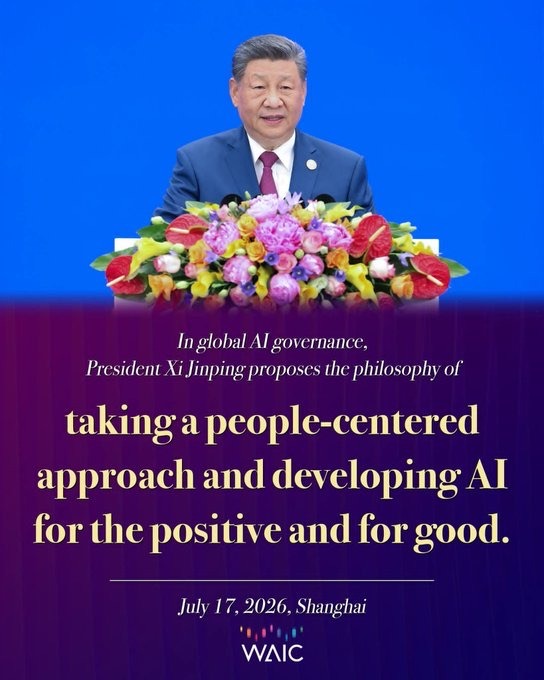
Chinese President Xi Jinping has called for a new era of international cooperation on artificial intelligence (AI), declaring that the technology’s future should be shaped collectively rather than dominated by individual nations, as he unveiled a comprehensive global capacity-building plan aimed at helping developing countries harness AI for sustainable development.
Delivering the keynote address at the opening ceremony of the 2026 World AI Conference and High-Level Meeting on Global AI Governance in Shanghai on Friday, Xi announced that China would provide 5,000 AI training opportunities for developing countries over the next five years, establish international AI application cooperation centres across multiple regional organisations, and expand access to its AI-powered meteorological warning system to 30 countries.
Describing AI as a shared asset of humanity, Xi said international cooperation remains essential to ensuring the technology benefits all nations.
“AI development should not be a solo performance by a single country, but a symphony of international cooperation,” the Chinese President said. “ Thanks to our joint efforts, the World Artificial Intelligence Cooperation Organization (WAICO) has come into being in Shanghai. This is a major move by China to answer the call of the Global South and unite the international community to promote AI development and governance.”
Xi said China would deepen AI partnerships with the Association of Southeast Asian Nations (ASEAN), the African Union (AU), the League of Arab States, the Community of Latin American and Caribbean States (CELAC), the Shanghai Cooperation Organization (SCO) and BRICS as part of efforts to bridge global AI and digital divides.
He urged countries to adopt a people-centred approach to AI development, warning that while artificial intelligence presents enormous opportunities for economic transformation and innovation, it also raises significant concerns relating to security, ethics, governance and equitable access.
According to Xi, the international community must collectively answer pressing questions surrounding human interaction with intelligent machines, algorithmic decision-making, AI ethics and widening technological disparities.
He outlined four guiding principles for global AI governance, advocating openness and innovation, stronger safeguards to ensure AI remains secure and under human control, protection of cultural diversity through inclusive AI development, and enhanced multilateral cooperation under the United Nations to establish globally accepted governance standards.
“We should ensure that AI is always under human control while jointly opposing the overstretching of the national security concept in the field of AI and placing one country’s security over that of others,” Xi said.
Highlighting China’s domestic AI achievements, Xi noted that the country’s core smart economy industries are now valued at more than one trillion yuan, while initiatives such as AI Plus have accelerated intelligent manufacturing, technological innovation and improvements in everyday life.
He added that China continues to strengthen its legal, regulatory and ethical frameworks to ensure AI develops safely and responsibly.
Xi also highlighted China’s contributions to international AI governance, including the Global AI Governance Initiative, the adoption of the United Nations General Assembly Resolution on Enhancing International Cooperation on Capacity Building of Artificial Intelligence, the AI Capacity Building Action Plan for Good and for All, and the AI Plus International Cooperation Initiative.
Calling for stronger global consensus on AI governance, Xi said emerging technologies must advance human well-being rather than deepen inequality.
“We must ensure AI development is for the positive, for good and for humanity. We should always guide AI development with human wisdom and international consensus so that AI can truly become a mighty force that increases the well-being of humanity and advances human civilization,” he said.
He reaffirmed China’s commitment to greater openness and practical international collaboration, expressing readiness to work with all countries to seize the opportunities presented by artificial intelligence while jointly addressing its challenges in pursuit of a shared future for humanity.