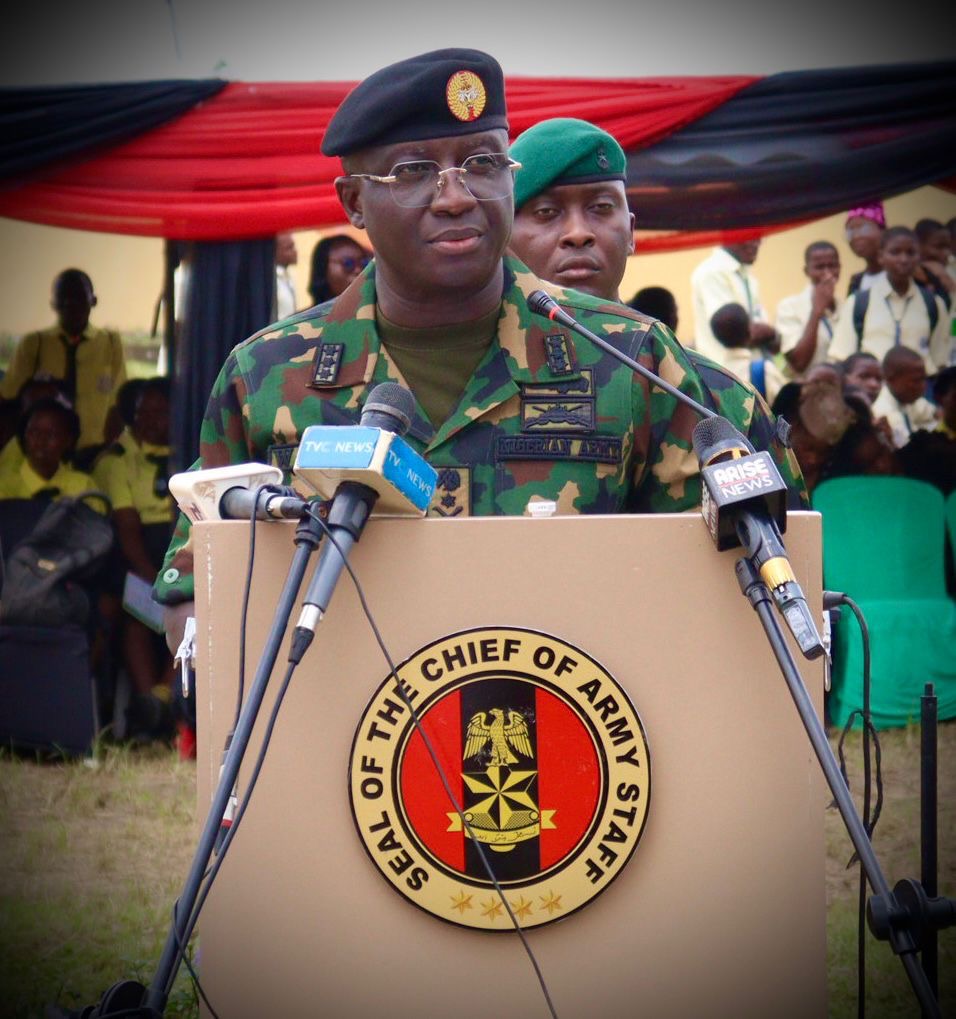
The Chief of Army Staff (COAS), Lieutenant General Waidi Shaibu, has reaffirmed the Nigerian Army’s commitment to placing people at the centre of national security with the commissioning of renovated schools, a community town hall and solar-powered boreholes across the three senatorial districts of Rivers State.
According to an official statement signed by the Director Army Public Relations, Colonel Appolonia Anele, the projects were commissioned on Sunday, 5 July 2026, as part of activities marking the Nigerian Army Day Celebration (NADCEL) 2026.
The statement said the projects include the renovation of Community Secondary School, Obio/Akpor Local Government Area in Rivers East Senatorial District; Community Secondary School, Lueku (Lussue), Khana Local Government Area in Rivers South-East Senatorial District; a Community Town Hall in Oyigbo Local Government Area, Rivers South-East Senatorial District; and a solar-powered borehole in Degema Local Government Area, Rivers West Senatorial District.
Speaking during the commissioning, Lieutenant General Shaibu described the interventions as a demonstration of the Nigerian Army’s commitment to strengthening its relationship with host communities through meaningful Civil-Military Cooperation (CIMIC) initiatives.
He said the projects were designed not only to improve infrastructure but also to address critical community needs that directly impact the lives of residents, stressing that the Army remains committed to complementing its operational responsibilities with initiatives that promote development and public trust.
The COAS noted that similar interventions, including the renovation of schools and town halls as well as the provision of solar-powered boreholes, are being implemented across the country to improve living standards and foster stronger collaboration between the military and civilians.
According to him, sustainable national security can only be achieved through collective responsibility, mutual trust and active community support, adding that military success is strengthened when citizens feel safe, included and empowered.
Lieutenant General Shaibu disclosed that the Nigerian Army has executed more than 250 intervention projects nationwide, covering hospitals, classrooms, roads, ICT centres, solar lighting systems and water facilities. He cited the transformation of previously dilapidated schools, including the one in Rumumasi, into conducive learning environments as evidence of the Army’s belief that quality education remains a critical foundation for lasting peace and national development.
The COAS commended the benefiting communities for their cooperation and urged residents to take ownership of the facilities by protecting and maintaining them for future generations.
He also expressed appreciation to President Bola Ahmed Tinubu, Commander-in-Chief of the Armed Forces of the Federal Republic of Nigeria, for his unwavering support towards enhancing the operational effectiveness of the Nigerian Army, while reaffirming the loyalty and commitment of officers, soldiers and civilian staff to the Constitution and the defence of Nigeria’s sovereignty and territorial integrity.
Earlier, the Chief of Civil-Military Affairs (Army), Major General Musa Etsu-Ndagi, explained that the projects were executed under the Nigerian Army’s Civil-Military Cooperation Programme to improve infrastructure and strengthen relationships with host communities.
He stated that four key intervention projects were strategically implemented across the three senatorial districts of Rivers State as part of NADCEL 2026 to ensure equitable distribution and maximum impact.
Also speaking, the Chairman of Obio/Akpor Local Government Area, Honourable Gift Worlu, described the projects as transformative, noting that the renovated schools would significantly improve the learning environment and restore hope to students, teachers and their communities.
He conveyed the appreciation of the people of Obio/Akpor and the wider Rivers community to the Nigerian Army and the Federal Government, assuring that the facilities would be adequately protected and properly maintained.
The commissioning ceremony highlighted the Nigerian Army’s continued commitment to complementing its constitutional responsibility of defending the nation with community-focused development initiatives aimed at promoting peace, strengthening public confidence and improving the wellbeing of Nigerians.