

By Nkechi Eze
The Federal Government has reaffirmed its commitment to the realization of the 1,028-kilometre Lagos–Abidjan Corridor project, a strategic regional highway expected to boost trade, mobility, and economic integration across West Africa.
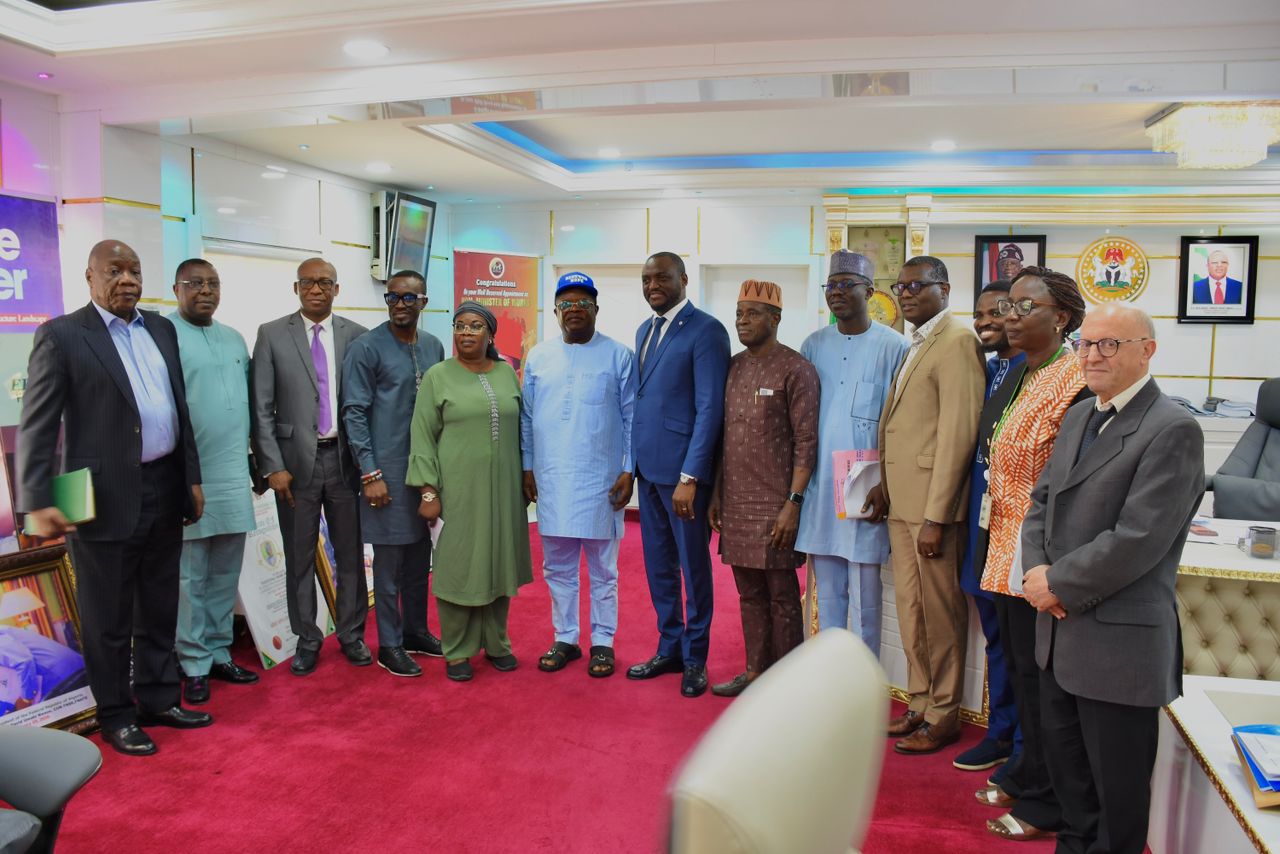
According to an official signed statement by the Senior Special Assistant to the Honourable Minister of Works (Media), Francis Nwaze, the assurance was given by the Minister of Works, Senator Engr. David Umahi, CON, during a high-level meeting with delegations from the ECOWAS Commission and the African Development Bank (AfDB) at his office in Mabutshi, Abuja, on Thursday.
The meeting, held in Umahi’s capacity as Chairman of the Steering Committee for the project and Nigeria’s ministerial representative, focused on reviewing progress and addressing outstanding technical and financing issues surrounding the transnational corridor, which links Abidjan in Côte d’Ivoire through Ghana, Togo, Benin Republic, and terminates in Lagos, Nigeria.
Speaking during the engagement, the minister conveyed the support of President Bola Ahmed Tinubu, GCFR, for the project, stressing that infrastructure development remains central to the administration’s economic and regional integration agenda.
Umahi noted that the Lagos–Abidjan Corridor, spanning approximately 1,028 kilometres, is being conceived to match the scale and ambition of Nigeria’s ongoing legacy highway projects, particularly the Sokoto–Badagry Superhighway. He disclosed that the project is expected to feature reinforced concrete pavement, three lanes on each carriageway, and modern engineering specifications designed for long-term durability.
He further linked the regional highway to Nigeria’s wider network of ongoing road infrastructure projects, including the Lagos–Calabar Coastal Highway and other strategic corridors traversing the country’s six geopolitical zones.
The minister disclosed that major sections of the Sokoto–Badagry route are already under construction, while additional segments are being processed for Federal Executive Council approval.
He stated that the Lagos–Abidjan project would significantly drive trade across West Africa and strengthen connectivity along the African coast, describing it as a critical component of broader regional economic transformation.
On the technical aspects of the corridor, Umahi acknowledged unresolved design concerns, particularly regarding the proposed engineering model and the distribution of corridor length among participating countries.
He explained that Nigeria’s section of the route, estimated at about 79.5 kilometres, would be executed to a higher specification than the original ECOWAS proposal, noting that the country had rejected aspects of the regional design considered impractical and not sufficiently aligned with existing infrastructure realities.
According to him, Nigeria is currently developing its own design framework tailored to the peculiarities of its road network and terrain, with the revised model expected to be completed within two weeks.
Umahi stressed that decisions on the project’s funding structure and implementation model would require approval at the level of heads of state before the project can move into procurement and full financing.
Despite the outstanding issues, he reaffirmed Nigeria’s full commitment to the project, noting that it would enhance regional trade, strengthen cross-border infrastructure connectivity, and deliver mutual economic benefits to member states.
Earlier, ECOWAS Director of Transport, Chris Appiah, said the mission formed part of ongoing consultations with member states on the technical framework for the highway, adding that engagements had already been held with Côte d’Ivoire, Ghana, and Togo, while consultations with Benin Republic would follow shortly.
The African Development Bank delegation, led by Salawou Mike Moukaila, described the corridor as a top financing priority for the bank, noting that efforts were underway to design a financing framework and mobilize co-financiers from within and outside Africa.
Moukaila said the project would serve as a major catalyst for regional integration, trade expansion, and infrastructure development, while emphasizing Nigeria’s strategic importance to the success of the corridor due to its dominant share of trade activity along the route.
He commended the Federal Government for its infrastructure drive and described the Lagos–Abidjan Corridor as a transformative project capable of reshaping connectivity across West, Central, and East Africa.