

By Nkechi Eze
The Secretary to the Government of the Federation, George Akume, has inaugurated a high-level technical committee to critically review a proposed $200 billion Integrated Gas, Power and High-Speed Rail Project aimed at transforming Nigeria’s infrastructure, boosting economic growth and strengthening the country’s position in the global energy and transportation sectors.
The project, which is designed as a large-scale infrastructure initiative, is expected to integrate gas development, power generation and transmission with a 4,000-kilometre high-speed rail network connecting major economic corridors across the country.
In a statement issued by the Head of Information and Public Relations in the Office of the Secretary to the Government of the Federation, Chris Ugwuegbulam, Akume emphasised the strategic importance of the initiative in transforming Nigeria’s transportation architecture and stimulating economic and industrial expansion.
According to him, the proposed project, estimated at $200 billion, is envisioned as a multi-phase programme that integrates gas development, electricity generation and transmission, alongside the construction of a 4,000-kilometre dual-track high-speed rail network linking major cities including Lagos, Abuja, Kano and Port Harcourt.
“The proposed project, which is estimated at Two Hundred Billion United States Dollars (US $200 Billion), is envisioned as a multi-phase programme that integrates gas development, power generation and transmission, and the construction of a 4,000-kilometre high-speed rail network connecting major economic corridors of the country, including Lagos, Abuja, Kano and Port Harcourt. The project has the potential to significantly transform Nigeria’s transport infrastructure, strengthen energy security, stimulate industrial growth and deepen national integration,” Akume said.
He explained that the technical committee has been mandated to thoroughly examine all relevant documentation related to the project, verify claims made by the proponents and assess its technical, legal and environmental implications.
The SGF noted that the committee would also provide objective, evidence-based recommendations to guide the Federal Government’s decision-making process regarding the project.
Akume urged members of the committee to approach the assignment with professionalism, objectivity and patriotism while engaging relevant stakeholders to ensure thorough due diligence and compliance with international best practices.
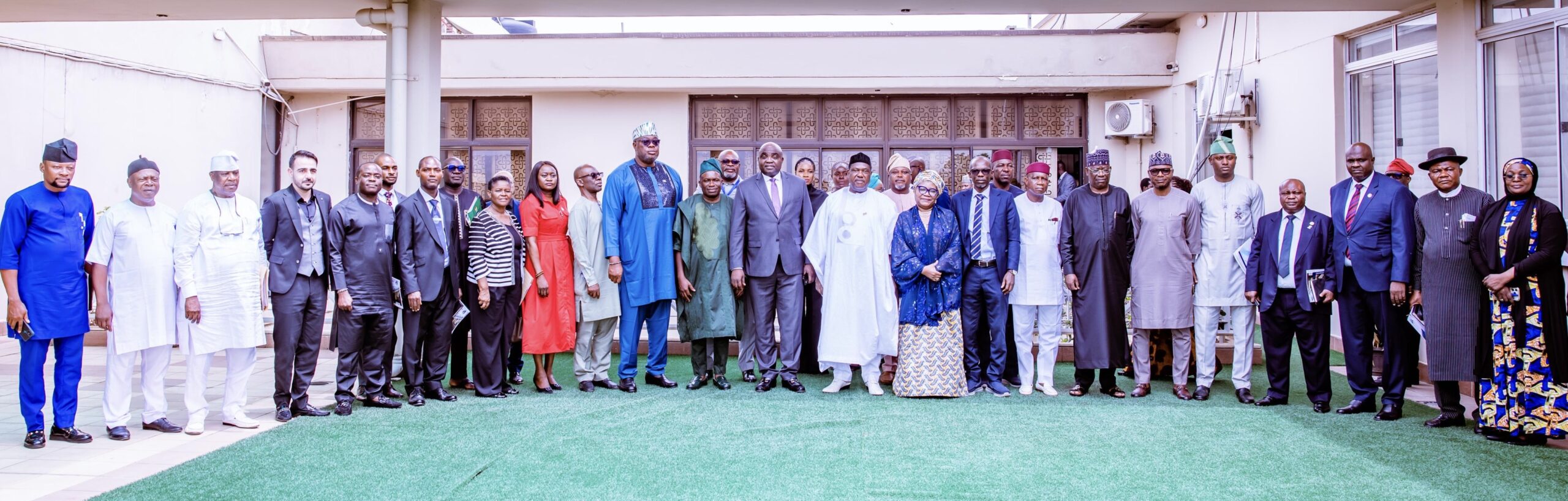
The committee is chaired by the Permanent Secretary in the Political and Economic Affairs Office of the Office of the Secretary to the Government of the Federation. Its membership includes Permanent Secretaries from the Federal Ministry of Transportation, Federal Ministry of Petroleum Resources, Federal Ministry of Finance, Federal Ministry of Justice and the Federal Ministry of Environment.
Other members of the committee include representatives from the Infrastructure Concession Regulatory Commission, Nigerian Electricity Regulatory Commission, Nigerian Communications Commission, the Nigeria Governors Forum, Central Bank of Nigeria, Nigerian Financial Intelligence Unit, Economic and Financial Crimes Commission, National Intelligence Agency, the Office of the National Security Adviser, Department of State Services, Debt Management Office and the Office of the Surveyor General of the Federation.
The Economic Monitoring and Research Department of the Office of the Secretary to the Government of the Federation will serve as the secretariat for the committee.
Presenting the details of the project, the Managing Director and Chief Executive Officer of De-Sadel Nigeria Limited, Samuel Ukoh, described the initiative as an innovative undertaking capable of significantly transforming Nigeria’s transport infrastructure.
Ukoh explained that the project would deliver a 4,000-kilometre dual-track high-speed rail network designed to reduce inter-city travel time by up to 75 percent while linking all 36 states of the federation and the Federal Capital Territory.
He added that the first phase of the project would connect key cities including Lagos, Abuja, Kano and Port Harcourt, while also generating about 3,500 megawatts of electricity to power the high-speed rail system.