


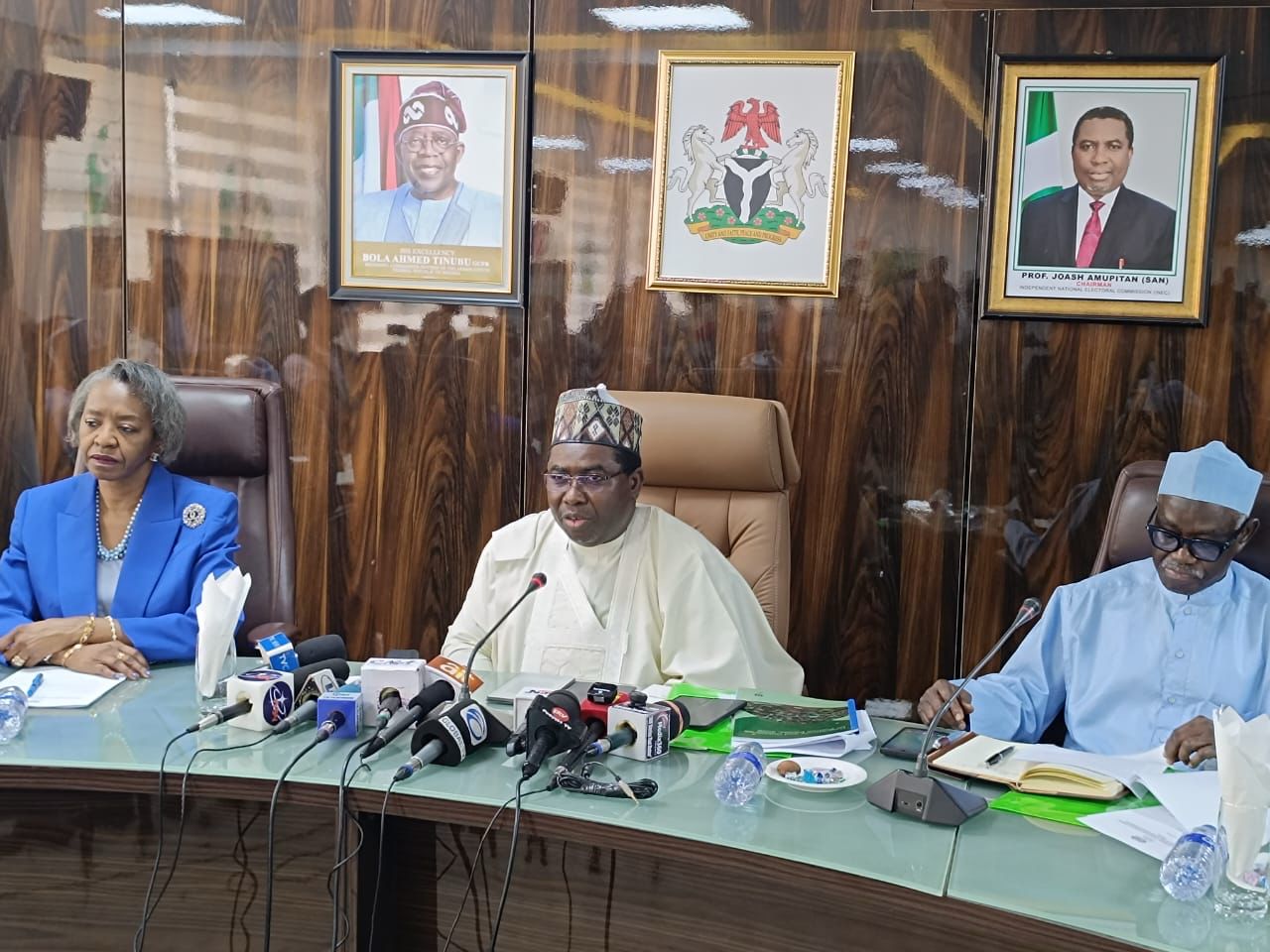
The Independent National Electoral Commission (INEC) has intensified efforts to strengthen Nigeria’s electoral process with the unveiling of a revised set of regulations and guidelines for political parties ahead of the 2027 general elections.
Speaking at a consultative meeting with leaders of political parties held at the Commission’s headquarters in Abuja on Tuesday, March 24, 2026, INEC Chairman, Professor Joash Amupitan, SAN, said the review was aimed at enhancing transparency, fairness, and credibility in the country’s democratic process.
He described the meeting as a critical platform not only to deliberate on the newly drafted INEC Regulations and Guidelines for Political Parties, 2026, but also to reaffirm a shared commitment among stakeholders to deepen democracy in Nigeria.
“We meet today not merely as regulators and political actors, but as joint custodians of Nigeria’s democratic future,” Amupitan said, noting that credible elections begin long before polling day, particularly in the processes that produce candidates.
The INEC Chairman explained that the revised regulations were developed following a comprehensive technical retreat earlier in the month, where the Commission undertook a clause-by-clause review of the 2022 guidelines to align them with provisions of the Electoral Act 2026.
“We cannot navigate a 2027 horizon using a 2022 map,” he stated, adding that the new framework is designed to be both legally robust and operationally effective.
He drew attention to Section 93(2) of the Electoral Act 2026, which empowers the Commission to determine election expenses for political parties in consultation with stakeholders, urging parties to take note of specific provisions dealing with the management of party primaries and election costs.
Amupitan further disclosed that the updated regulations address key areas such as party registration and mergers, internal operations, conduct of primaries, campaign activities, political financing, and conditions for deregistration. He said the guidelines also incorporate measurable benchmarks to promote the participation of women, youth, and Persons with Disabilities.
According to him, the reforms were informed by empirical findings from the Political Party Performance Index developed with support from the Westminster Foundation for Democracy, which revealed significant gaps between party constitutions and grassroots realities.
With the Presidential and National Assembly elections scheduled for January 16, 2027, and the Governorship and State Assembly elections fixed for February 6, 2027, the INEC Chairman noted that the Commission is operating within a compressed timeline due to changes introduced by the Electoral Act 2026.
“This demands what I call surgical precision,” he said, urging political parties to engage constructively with the draft regulations, which he described as safeguards designed to protect the will of the Nigerian electorate.
Amupitan maintained that INEC remains a neutral umpire but would not remain passive in the face of practices that undermine democratic values. “Together, let us build an electoral ecosystem where the rules are clear, the playing field is level, and the outcome is beyond reproach,” he added.
In his response, the National Chairman of the Inter-Party Advisory Council (IPAC), Dr. Yusuf Mamman Dantalle, raised concerns over provisions of the Electoral Act 2026, describing it as a setback to Nigeria’s democratic progress.
He argued that the Act has placed undue pressure on political parties, particularly those not in government, and called on the National Assembly to urgently amend contentious provisions, including the mandatory use of direct primaries.
Dantalle also criticised the requirement for political parties to submit membership registers with National Identification Numbers within a short timeframe, warning that it could disenfranchise many Nigerians.
He further called for the restoration of mandatory electronic transmission of election results, stronger penalties for vote buying, and the establishment of an Electoral Offences Commission to enhance accountability.
Despite the concerns, he reaffirmed IPAC’s commitment to constructive engagement with INEC, stressing the need for collaborative efforts to ensure credible, transparent, and inclusive elections in 2027.
The meeting brought together party leaders, national commissioners, and senior officials of the Commission, underscoring the importance of sustained dialogue in shaping a credible electoral framework for Nigeria.