By Nkechi Eze
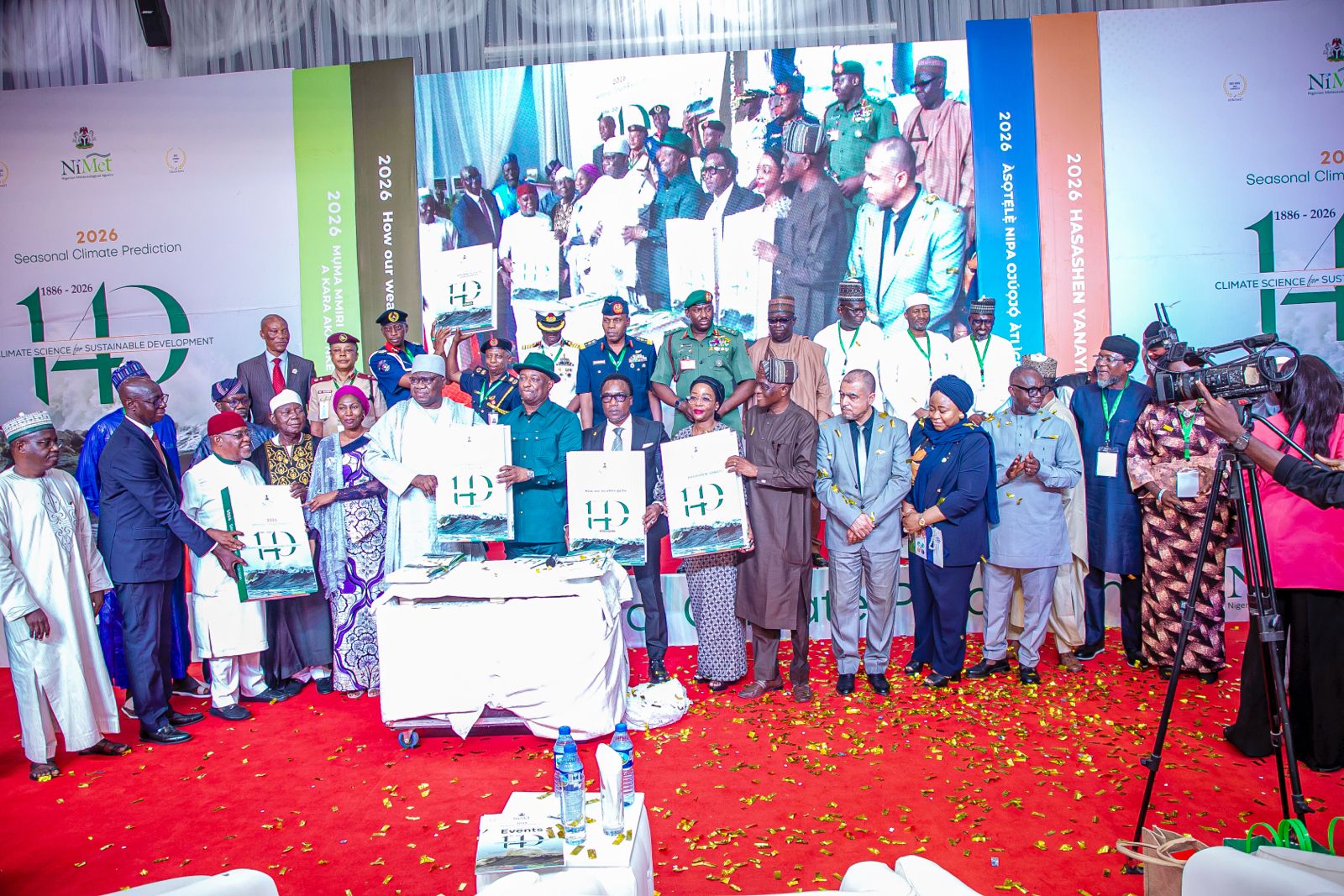
Nigeria’s climate outlook for 2026 presents a complex mix of early and late rainfall onset, shifting cessation periods, prolonged dry spells, above-normal temperatures and heightened sectoral risks, as the Nigerian Meteorological Agency (NiMet) officially unveiled the 2026 Seasonal Climate Prediction (SCP) in Abuja, reinforcing the growing urgency for climate-informed national planning.
The SCP was formally presented on February 10, 2026, at the Nigerian Air Force Conference Centre, Abuja, in the presence of top government officials, policymakers, scientists, development partners and private sector stakeholders. The event also featured the presentation of the 2025 State of the Climate in Nigeria, further strengthening the link between climate science, economic resilience and national development.
Delivering the keynote address, the Honourable Minister of Aviation and Aerospace Development, Barrister Festus Keyamo, described the Seasonal Climate Prediction as a strategic national asset that has evolved beyond routine forecasting into a critical tool for governance and economic decision-making.
“The Seasonal Climate Prediction is no longer just about weather forecasts,” Keyamo said. “It has become a vital instrument for national planning, investment decisions, disaster risk reduction and economic resilience.”
He noted that NiMet’s early warning products have, in recent years, contributed significantly to improved agricultural productivity and enhanced disaster preparedness across the country, earning commendations from both public and private sector users.
According to the minister, climate variability and climate change have become defining realities of modern governance, with direct implications for aviation safety, food security, national security planning, infrastructure development and the general wellbeing of citizens.
“Extreme weather events such as heatwaves, droughts, severe thunderstorms, windstorms and sandstorms now occur with alarming frequency,” Keyamo observed. “This reality makes it imperative for governments to embed climate data, meteorological science and early warning systems at the core of national planning frameworks.”
He stressed that under the leadership of President Bola Ahmed Tinubu, GCFR, the Federal Government has prioritised economic stability, food security, infrastructure resilience, climate adaptation and the protection of lives and livelihoods.
“In this context, timely and accurate weather and climate information is no longer optional,” he said. “It is a strategic enabler of development and good governance. The 2026 SCP aligns directly with the Renewed Hope Agenda by translating complex climate signals into actionable guidance for policymakers and investors across all sectors.”
Reaffirming his ministry’s commitment to NiMet, Keyamo said reliable meteorological services remain indispensable to safe, efficient and sustainable aviation.
“There can be no safe aviation without credible meteorological input,” he said. “Beyond safety, climate data is essential to building an aviation and aerospace sector capable of supporting Nigeria’s growing population and economic aspirations.”
Providing historical context, the minister traced Nigeria’s climate forecasting roots to 1886, when the country’s first weather observing station was established, commending NiMet for evolving into a modern, multi-sectoral agency.
“For over 140 years, NiMet has grown into an institution whose services cut across agriculture, disaster risk reduction, water resources, health, transportation, energy planning and national security,” he said.
On the scientific basis of the forecast, Keyamo disclosed that the 2026 SCP was produced using global best practices, combining long-term climatological data, current observations and major global climate drivers such as the El Niño–Southern Oscillation and the Indian Ocean Dipole.
“Indicators for 2026 point to a predominantly neutral ENSO phase,” he explained. “This has important implications for rainfall distribution, temperature patterns and sector-specific risks across the country.”
He cautioned Nigerians against misinterpreting early rains already observed in parts of southern Nigeria as the official onset of the rainy season.
“I want to strongly advise farmers and other rainfall-dependent users not to rely on isolated early rains,” Keyamo warned. “They should follow the predicted onset dates or consult NiMet directly for guidance.”
The SCP projects early rainfall onset in states including Bayelsa, Rivers, Akwa Ibom, Cross River, Benue, Kogi, Nasarawa and Oyo, while Borno State is expected to experience a late onset. Rainfall cessation is forecast to be earlier than normal in parts of Ogun, Osun, Ondo, Imo, Rivers, Akwa Ibom, Kogi and Niger States, while a delayed end of the season is projected for Lagos, Ogun, Anambra, Enugu, Cross River, Benue, Nasarawa and Kaduna States.
Near-normal annual rainfall is expected across most of the country, with above-normal rainfall predicted for states including Borno, Sokoto, Kebbi, Kaduna, Enugu, Cross River, Abia, Ebonyi, Akwa Ibom and the Federal Capital Territory, while below-normal rainfall is forecast for parts of Katsina, Zamfara, Kwara, Oyo and Ogun States.
Significant dry spell risks were also highlighted, including severe dry spells exceeding 15 days between March and May in parts of Oyo and Ogun States, and prolonged dry spells of up to 21 days during the June–July–August period across several northern and central states. The August Break is expected to be severe and prolonged over Lagos, Ogun, Ekiti and parts of Oyo States.
In his welcome address, the Permanent Secretary of the Ministry, Dr. Yakubu Adam Kofarmata, described the SCP unveiling as a flagship national platform for integrating climate science into development planning.
“Seasonal climate forecasts are critical to aviation safety, agriculture, water management, disaster risk reduction, public health, transportation, energy and infrastructure development,” Kofarmata said. “In a climate-sensitive country like Nigeria, credible climate information is indispensable.”
He urged stakeholders to go beyond receiving the forecast and actively apply it in policy formulation, investment decisions and preparedness planning.
Earlier, the Director-General and Chief Executive Officer of NiMet, Prof. Charles Anosike, reaffirmed the agency’s commitment to delivering authoritative, science-based climate services in an era of increasing climate extremes.
“We remain committed to providing timely, reliable and actionable climate information to support informed decision-making,” Anosike said. “NiMet is also integrating emerging technologies, including Artificial Intelligence, into its forecasting operations, with a dedicated team already established for AI-driven climate services.”
He paid tribute to the agency’s pioneer Director-General, Chief Lihwu Eugene Akeh, and thanked the Federal Government and the Minister for their sustained support.
“This support is critical to advancing climate-smart, data-driven development in Nigeria,” Anosike noted, while calling for stronger partnerships with state governments to downscale the SCP to local communities, especially farmers.
As Nigeria confronts intensifying climate risks, the 2026 Seasonal Climate Prediction stands as a central national planning tool, underscoring the country’s commitment to science-based governance, resilience building and sustainable development in an increasingly uncertain climate future.