


By Nkechi Eze
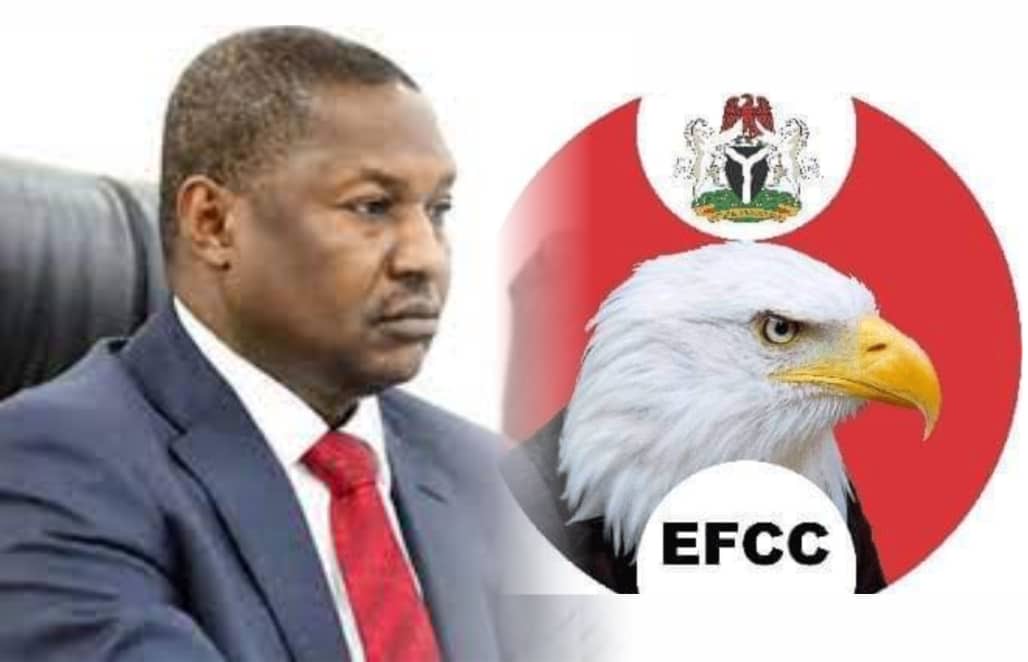
Court filings by the Economic and Financial Crimes Commission (EFCC) have laid bare the details of an extensive criminal case that, once it formally commences, will place former Attorney-General of the Federation, Abubakar Malami, SAN, under intense legal and public scrutiny. At this stage, however, the matter remains at the level of filed charges, with no trial yet underway and no judicial determination made on the allegations.
The charge sheet, running into multiple counts, outlines what investigators describe as a complex web of alleged money laundering, concealment of proceeds of unlawful activities and acquisition of high-value assets through layered financial arrangements. According to the EFCC, the investigation spans nearly a decade and cuts across different political administrations, banking channels, corporate entities and prime real estate holdings located in Abuja, Kebbi and Kano.
In documents submitted to the court, the anti-graft agency alleges that during and after his tenure as the nation’s chief law officer, Malami utilised a network of companies, associates and employees to move, retain and disguise large sums of money suspected to be proceeds of unlawful activities. The EFCC claims that these funds were allegedly structured in ways designed to obscure beneficial ownership, conceal their origin and integrate them into real estate and hospitality ventures, including luxury residences and hotel properties in some of the most exclusive districts of the Federal Capital Territory.
The charge sheet further alleges a recurring pattern in which funds passed through corporate bank accounts, were used as cash collateral for sizeable loans, or were channelled into property acquisitions registered in the names of companies and proxies. Some of the alleged transactions, according to the EFCC, occurred while Malami was serving as Attorney-General of the Federation, a position that placed him at the heart of Nigeria’s justice system and entrusted him with advising the Federal Government on sensitive legal and prosecutorial matters.
Also named in several of the counts are Abubakar Abdulaziz Malami and Hajia Bashir Asabe, described in the filings as an employee of Rahamaniyya Properties Ltd. The EFCC alleges that they acted in concert with Malami in concealing or disguising the origins of funds and assets referenced in the charge sheet. The alleged offences are said to fall under both the Money Laundering (Prohibition) Act 2011, as amended, and the Money Laundering (Prevention and Prohibition) Act 2022, reflecting the prolonged timeframe of the alleged conduct.
Altogether, the EFCC has filed a 16-count charge detailing specific dates, amounts, bank accounts and properties, which the commission says form part of a sustained scheme to launder illicit funds and convert them into long-term assets. The agency emphasises that these particulars are allegations that will be subjected to judicial testing once the trial formally begins.
Beyond the legal specifics, the filed charges have already assumed wider public significance because of the office Malami once occupied. As Attorney-General of the Federation, he was the country’s chief law officer, the custodian of federal legal authority and a central figure in Nigeria’s justice architecture for nearly eight years. Allegations against a former holder of that office inevitably resonate beyond the courtroom, touching on issues of public trust, institutional integrity and the credibility of the rule of law.
It is precisely for this reason that the case has become an important moment for Nigeria’s anti-corruption framework, even before the commencement of trial. The EFCC’s decision to file charges against a former Attorney-General sends a signal that no office is, in principle, immune from investigation. At the same time, the presumption of innocence remains fundamental, and Malami, like every defendant, is entitled to a fair hearing and full opportunity to challenge the allegations in court.
For the public, this stage of the process calls for discernment rather than judgment. Supporting the EFCC does not mean assuming guilt; it means supporting the right of lawful institutions to investigate allegations, place them before the courts and allow evidence not sentiment or political loyalty to determine outcomes. In high-profile cases, public cynicism, disinformation and politicisation often become tools to weaken accountability before trials even begin. When that happens, the justice system itself becomes the casualty.
The broader implications are difficult to ignore. Allegations of corruption at senior levels are not abstract legal issues; they intersect directly with citizens’ lived realities. Resources allegedly diverted into luxury properties and complex financial structures represent, in the public imagination, resources unavailable for healthcare, education, infrastructure and security. Even at the allegation stage, such cases underline why accountability remains central to national development.
The charges also highlight the evolving sophistication of financial crime. Modern money laundering, as reflected in the EFCC’s filings, is rarely straightforward. It involves layered transactions, corporate vehicles, proxies and real estate investments that demand technical expertise and long-term investigative commitment to unravel. That the commission has assembled a detailed charge sheet spanning years of transactions points to the increasing complexity and importance of financial crime enforcement in Nigeria.
As the case awaits formal commencement, it stands as a test of institutional resilience rather than individual fate alone. How the EFCC proceeds, how the courts manage the process and how the public responds will all shape perceptions of Nigeria’s commitment to accountability. Allowing the legal process to unfold without pressure, prejudice or interference is essential to safeguarding the credibility of the justice system.
In the end, the charges against Abubakar Malami have already entered Nigeria’s public record, not as findings of guilt, but as allegations demanding judicial scrutiny. What follows must be governed by law, evidence and due process. In that discipline lies the true measure of a society’s seriousness about fighting corruption and upholding the rule of law.