

By Nkechi Eze
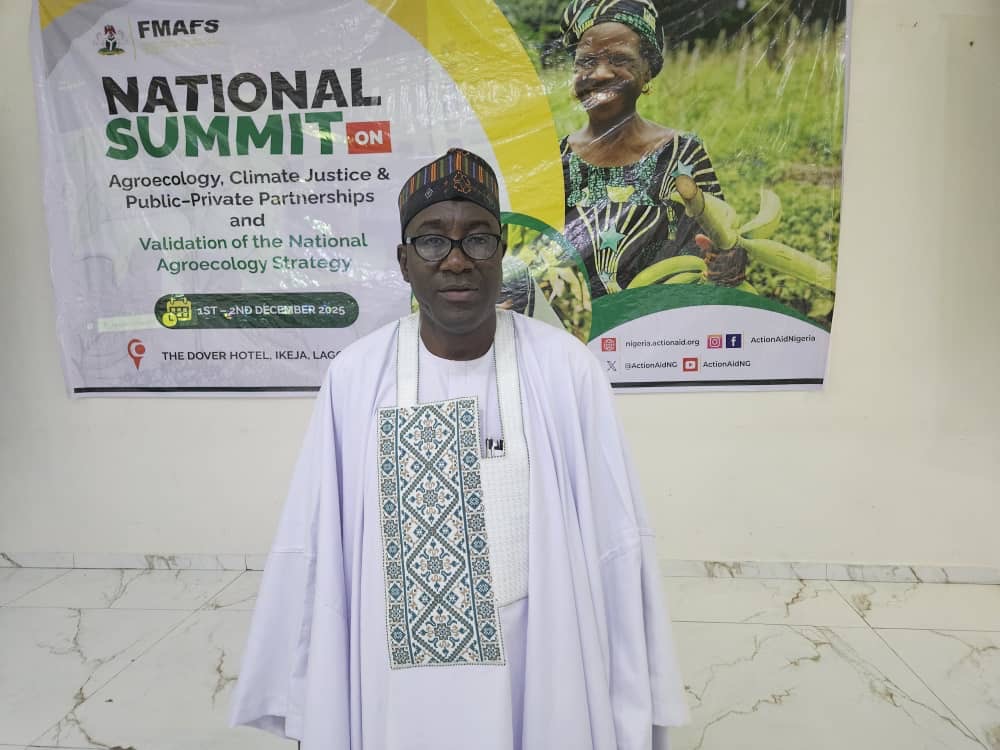
Nigeria’s drive toward climate-resilient and innovation-led agriculture took centre stage on Monday as the National Summit on Agroecology and Public-Private Partnership opened in Lagos, with experts, development partners, and government representatives converging to shape the nation’s future food systems. The two-day summit, organised by the Federal Ministry of Agriculture and Food Security in collaboration with ActionAid Nigeria, focuses on agroecology, climate justice and sustainable agricultural transformation in the face of rising environmental challenges.
Speaking at the opening, the Executive Secretary of the Agricultural Research Council of Nigeria (ARCN), Dr. Abubakar Adamu Dabban, said the country’s agricultural future depends on adopting research-driven solutions, scaling innovation, and strengthening climate-smart practices across all farming communities. In a statement signed by the Public Relations Officer in the Office of the Executive Secretary, Khadijat O. Ameen, Dr. Dabban described the summit as a pivotal moment for aligning national priorities with global best practices for sustainable agriculture.
Dr. Dabban reaffirmed ARCN’s commitment to leading transformative, farmer-centred research while building stronger partnerships to support resilience and productivity across the agricultural value chain. He noted that Nigeria possesses immense comparative advantages, including fertile land, favourable agroecological zones, a growing industrial base and a resilient farming population which must be harnessed more effectively through innovation, investment and collaboration. According to him, the summit will play a key role in validating the National Strategy on Agroecology, which focuses on sustainable natural resource management, transition pathways for farmers, and enhanced market systems.
Expressing appreciation for the collaboration between ActionAid Nigeria and the Federal Ministry of Agriculture and Food Security, Dr. Dabban said the ARCN is motivated by the shared commitment driving the summit. He reminded participants of the Council’s mandate, stating, “The ARCN coordinates, supervises and regulates 16 agricultural research institutes and 17 federal colleges of agriculture across the country. These institutions have mandates to conduct research into various agricultural commodities in crop, livestock and fisheries, while the colleges train middle-level manpower in all aspects of agriculture.”
Dr. Dabban emphasised that the summit provides an invaluable platform for experience sharing, idea generation and collective action capable of shaping a more food-secure future for the country. “This summit therefore provides an invaluable platform for discussions and sharing of experiences which will inspire new ideas and collaborations that will drive positive change in our agricultural practices and contribute to a more food-secure future for all,” he said.
He reaffirmed that the Agricultural Research Council of Nigeria remains committed to offering robust scientific support, coordinating national research programmes and nurturing partnerships that stimulate transformation across the entire agricultural value chain. Pledging ARCN’s continued collaboration with all stakeholders, he added: “We stand ready to collaborate with all stakeholders represented here today. I am confident that the outcomes of this summit will set a new direction for sustainable growth and prosperity for agroecology, public-private partnership and the Nigerian economy at large.”