

By Nkechi Eze
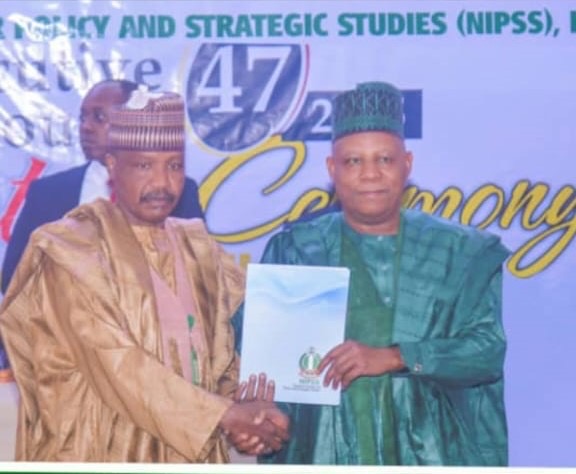
Musa Ibrahim Alkali, Director of Administration and Human Resource at the Independent Corrupt Practices and Other Related Offences Commission (ICPC), has joined the elite circle of Nigerian public sector strategists after being awarded the distinguished Member of the National Institute (mni) title at the National Institute for Policy and Strategic Studies (NIPSS), Kuru, Plateau State.
Alkali earned the honour after successfully completing the Senior Executive Course, NIPSS’s flagship ten-month residential programme tailored for top-level policymakers and senior executives drawn from across the country. The programme is designed to sharpen participants’ strategic thinking, leadership capacity and policy implementation skills in line with national development priorities.
According to a statement issued by the Spokesperson and Head of Media and Public Communications of the ICPC, Mr. J. Okor Odey, Alkali made a strong scholarly contribution during the course through a policy-based research work that interrogated the operations and impact of constituency projects within Nigeria’s anti-corruption landscape.
The study, titled “ICPC’s Federal Constituency Projects Tracking Initiative and the Anti-Corruption Crusade in Nigeria: An Appraisal of Kano State,” examined how effectively constituency projects are funded, implemented and monitored, and how these processes can be strengthened to curb abuse and wastage.
A major finding of the research is the need for an upward review of constituency project allocations by 25 per cent, combined with more rigorous supervision and tracking mechanisms. Alkali maintained that better funding, when matched with strict oversight, would translate into improved infrastructure delivery and reduced opportunities for corruption.
He further noted that constituency projects, if properly administered, represent one of the most practical avenues through which government can address local development challenges. He cautioned, however, that misconceptions about the ownership of such projects have weakened accountability.
“These projects are not personal gifts from legislators; they are financed with public funds,” Alkali stressed, calling for sustained public enlightenment so that citizens understand their rights and responsibilities in demanding value for money.
To deepen accountability, Alkali proposed that the ICPC’s mandate in relation to constituency projects should be strengthened. He suggested either a review of the Commission’s establishing law or the introduction of a fresh executive directive that would grant the agency clearer and stronger powers to sanction lawmakers and other officials who compromise project execution.
Kano State was selected as the focal point of the study because of its large population size, wide spread of local government areas and high number of federal constituencies, making it a suitable model for drawing lessons with national relevance.
Speaking on the impact of the programme, Alkali described his stay at NIPSS as a defining professional experience that broadened his perspective on policy formulation and strategic governance. He expressed appreciation to the ICPC leadership for the opportunity and affirmed his commitment to applying the knowledge gained to further strengthen the Commission’s operations.
The mni designation is widely recognised as one of the most respected professional distinctions in Nigeria’s public service, symbolising advanced training in leadership, strategy and national policy development. Alkali’s elevation, therefore, represents both a personal achievement and an institutional gain for the ICPC as it continues to reposition itself for greater effectiveness in the anti-corruption fight.