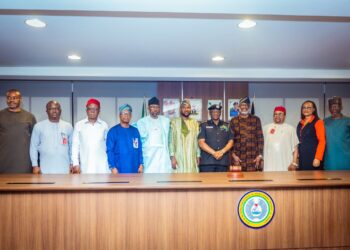
Against the backdrop of rapidly evolving security threats and an increasingly complex global operating environment, the Chief of Defence Staff (CDS), General Olufemi Oluyede, has reaffirmed that continuous transformation and innovation are indispensable to the operational effectiveness and relevance of the Armed Forces of Nigeria (AFN).
General Oluyede made this position known at the Fourth Quarter Armed Forces of Nigeria Transformation and Innovation Seminar organised by the Department of Defence Transformation and Innovation (DDTI), where he was represented by the Director of Search and Rescue at Defence Headquarters, Air Vice Marshal I. Sani. The seminar, which attracted senior military leaders, defence experts and key stakeholders, focused on practical pathways for repositioning the Armed Forces to meet present and future security demands.
Speaking on the theme, “Optimising the Armed Forces of Nigeria’s Operational Capabilities Through Transformation and Innovation: Issues and Prospects,” the CDS observed that modern warfare has transitioned into a volatile, uncertain, complex and ambiguous environment, where conventional and non-conventional threats now intersect in unprecedented ways. He noted that terrorism, insurgency, cyber warfare, information operations and the proliferation of emerging technologies among both state and non-state actors have fundamentally altered the character of conflict and imposed new operational demands on the military.
According to him, the evolving threat landscape requires an Armed Forces that is agile, adaptive and forward-leaning in both strategy and execution. He stressed that transformation is no longer a matter of choice but an operational necessity, calling for constant review of military doctrines, modernisation of platforms, expansion of capabilities and the deliberate integration of emerging and disruptive technologies. He added that institutional culture must equally evolve to embrace learning, innovation and continuous improvement across all levels of command.
General Oluyede described innovation as a critical enabler of operational success, noting that contemporary militaries increasingly depend on new ideas and advanced technologies to improve situational awareness, enhance force protection, increase precision and achieve mission objectives. He highlighted the growing importance of unmanned systems, artificial intelligence, robotics, autonomous platforms, space-based assets and data analytics in modern military operations, stressing that these capabilities now shape both tactical and strategic outcomes.
To remain competitive and effective, the CDS said the Armed Forces of Nigeria must prioritise indigenous research and development, deepen partnerships with academia and industry, strengthen inter-service cooperation and invest consistently in capacity-building programmes that equip personnel with future-ready skills. He emphasised that self-reliance and innovation driven by local expertise are critical to sustaining long-term operational effectiveness.
Commending the Department of Defence Transformation and Innovation, General Oluyede described the seminar as a strategic platform for shaping the future of the Armed Forces. He noted that the department has continued to demonstrate consistency and professionalism in driving initiatives spanning doctrine development, digital transformation, promotion of local content and coordination with key stakeholders.
The CDS explained that the Armed Forces’ transformation agenda is firmly anchored on his strategic philosophy, which seeks to consolidate military capabilities through enhanced jointness, a reinforced operational posture and improved welfare, supported by sound administration and aligned with a whole-of-government approach to national security. He stressed that improved joint operations, interoperability and synergy among the services and relevant agencies are essential to boosting readiness and responsiveness across all theatres of operation.
He further underscored that transforming the Armed Forces must go beyond platforms and technology to include the welfare and wellbeing of personnel. According to him, improved housing, medical support, training opportunities and clear career progression are critical to sustaining morale, discipline and loyalty, warning that no level of technological advancement can compensate for a demoralised fighting force.
Also speaking at the seminar, the Director of Monitoring and Evaluation at the DDTI, Air Vice Marshal Jeff Ekwuribe, said the forum provides a valuable opportunity to critically examine existing gaps in force structure, review lessons from ongoing operations and identify new pathways to enhance operational effectiveness. He noted that optimising military capability goes beyond equipment acquisition and must include doctrine development, adaptive training, intelligence enhancement, logistics modernisation, digital transformation and leadership development across the services.
Air Vice Marshal Ekwuribe added that national security and military power are products of effective cooperation between the military and the civil sector, including political leadership, the economy, industry, education and society at large. He emphasised that public trust and strong civil-military relations remain vital to sustaining national security and operational legitimacy.
The seminar also featured a keynote presentation by Professor Ehiz E. Odigie-Okpatakun, a behavioural change and non-kinetics strategy consultant, who highlighted the role of behavioural change, regimental enhancement and non-kinetic strategies in strengthening military effectiveness in contemporary operations.
The event brought together senior officers, departmental chiefs, directors, subject-matter experts and stakeholders to deliberate on innovative approaches aimed at repositioning the Armed Forces of Nigeria as a people-centred, technologically enabled and future-ready force capable of safeguarding Nigeria’s sovereignty, stability and prosperity.